Getting an AI agent into production is a major milestone.
But going live is not the same as being successful.
An AI agent may handle thousands of customer conversations, answer questions around the clock, and reduce the number of interactions reaching live agents.
Those numbers may look impressive on a dashboard.
But they do not necessarily tell you whether customers are getting the help they need.
Are requests being completed correctly? Are customers contacting the company again because the AI failed to resolve the issue? Are employees spending additional time fixing mistakes or completing work the AI could not finish?
These are the questions contact center leaders should be asking after deployment.
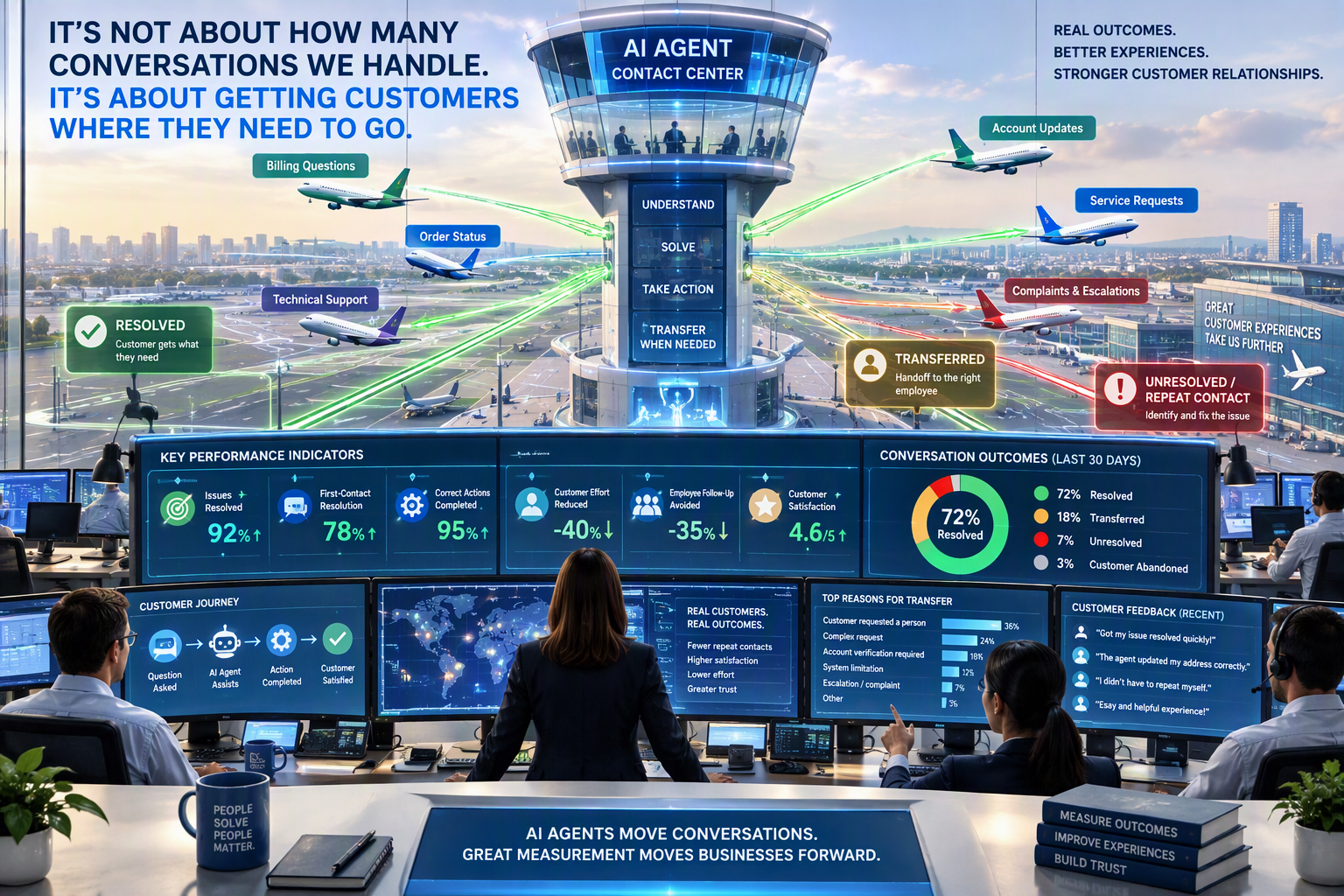
The real measure of AI success is not how many conversations it handles. It is how effectively those conversations lead to the right customer outcomes.
Here are seven areas contact centers should monitor to understand whether their AI investment is delivering meaningful results.
1. Measure Customer Resolution, Not Just AI Containment
Containment rate is one of the most commonly discussed metrics in AI-powered customer service.
It measures how many interactions remain within the automated experience without being transferred to a human agent.
That information is useful, but it does not tell the entire story.
A conversation ending without a transfer does not automatically mean the customer's issue was resolved.
Consider a customer who asks an AI chatbot about a billing charge. The chatbot provides an incomplete answer, and the customer leaves the conversation.
The interaction may appear contained.
But if that customer calls the contact center the following day to ask the same question, the original issue was never truly resolved.
This is why contact centers need to distinguish between containment and successful resolution.
Key Metrics to Monitor
- AI containment rate
- Verified task completion rate
- First contact resolution (FCR)
- Repeat contact rate
- Customer abandonment rate
- Resolution rate by interaction type
Practical Ways Contact Centers Can Implement This
- Verify outcomes across systems. Connect AI reporting with CRM and transaction records to confirm whether requests were actually completed.
- Track repeat contacts. Identify customers who return with the same issue within a defined period appropriate to the request.
- Compare containment with resolution. Investigate situations where containment improves but repeat contacts or unresolved issues increase.
The goal should not be keeping every customer away from a human agent.
It should be resolving the issue through the most appropriate channel.
2. Monitor AI Response Accuracy and Task Completion
An AI conversation can sound natural, helpful, and professional while still producing the wrong outcome.
That is one of the biggest risks contact centers need to monitor after deployment.
For example, an AI agent might tell a customer that their mailing address has been updated.
But did the change actually save in the CRM?
Was the correct account updated?
Did the customer receive accurate confirmation?
These questions matter because there is a difference between providing an answer and completing a task.
Contact centers should measure both.
For informational interactions, AI responses should be checked against current, approved knowledge sources.
For transactional interactions, the completed action should be verified against the system of record.
Key Metrics to Monitor
- Response accuracy rate
- Successful task completion rate
- Failed transaction rate
- AI correction rate
- Knowledge accuracy
- Security and compliance exceptions
Sensitive workflows require additional attention.
An incorrect store-hours response and an incorrect payment instruction should not be treated as equally serious errors.
Practical Ways Contact Centers Can Implement This
- Audit a representative sample of interactions. Review routine conversations alongside complaints, escalations, and known failures.
- Separate incorrect answers from failed actions. This helps teams determine whether the problem involves knowledge, AI behavior, or a system integration.
- Create critical error alerts. Flag issues involving authentication failures, incorrect disclosures, unauthorized actions, or sensitive customer information for immediate review.
A strong overall quality score should never hide a serious failure in a high-risk interaction.
3. Evaluate AI Escalation and Human Transfer Performance
Not every customer interaction should be handled entirely by AI.
Some requests require judgment, empathy, policy exceptions, or human approval.
That means transferring a conversation is not necessarily a sign that the AI failed.
Sometimes, escalation is exactly the right outcome.
The important question is whether the transfer happened for the right reason, at the right time, and with the right information.
Contact centers should understand why customers are being transferred.
Was the customer requesting a person?
Did the AI recognize that it could not resolve the issue?
Was information missing?
Did an integration fail?
These details are far more useful than a single overall transfer percentage.
Key Metrics to Monitor
- AI to human transfer rate
- Transfer reasons
- Customer-requested escalation rate
- Successful transfer rate
- Resolution rate after transfer
- Average time before escalation
- Repeat information rate
Practical Ways Contact Centers Can Implement This
- Categorize transfer reasons. Track transfers by customer intent, system failure, knowledge gap, and human assistance requests.
- Review the handoff experience. Confirm that agents receive accurate summaries, collected information, and the steps the AI already attempted.
- Investigate unusual transfer trends. A sudden increase in transfers may indicate a broken workflow, while a decrease may signal that customers are struggling to reach a person.
A successful AI escalation strategy should make the transition to a human feel like a continuation of the conversation.
4. Track Customer Effort and Satisfaction
Customer satisfaction remains an important measure of AI performance.
But relying on CSAT alone can leave important gaps.
A customer might complete a request successfully but still experience unnecessary frustration along the way.
Maybe the AI asked for the same information multiple times.
Maybe the customer had to rephrase their question repeatedly.
Or perhaps the interaction took much longer than expected.
These issues may not always appear in a satisfaction score, especially when only a small percentage of customers complete surveys.
That is why customer effort deserves attention.
Key Metrics to Monitor
- Customer satisfaction (CSAT)
- Customer effort score (CES)
- Repeated question frequency
- Rephrasing rate
- Conversation abandonment
- Negative customer sentiment
- Customer complaints related to AI
Practical Ways Contact Centers Can Implement This
- Analyze conversation friction. Look for repeated questions, unnecessary steps, and phrases such as "That's not what I asked."
- Review survey participation. Consider response volume and interaction type before interpreting changes in CSAT.
- Collect agent feedback. Give employees an easy way to report recurring customer frustrations they encounter after AI handoffs.
Sometimes employees will identify a problem before it becomes obvious in the dashboard.
That feedback should be treated as valuable operational data.
5. Monitor Response Times and System Reliability
AI is often introduced to make customer service faster.
But faster responses do not automatically mean faster resolution.
An AI agent might respond immediately to a customer's first question, then spend several minutes waiting for a connected system to complete a request.
Or it may repeatedly ask clarifying questions without making progress.
Contact centers need visibility into the entire interaction, not just the initial response.
Key Metrics to Monitor
- AI response time
- Total conversation duration
- Time to resolution
- Integration response time
- System timeout rate
- Failed API requests
- Long-duration interaction rate
Practical Ways Contact Centers Can Implement This
- Monitor slow interactions separately. Review unusually long conversations rather than relying only on average response times.
- Track integration performance. Determine whether delays come from AI processing, customer understanding, or connected systems.
- Test common workflows regularly. Confirm that account retrieval, updates, and transactions continue functioning as expected.
If a process that previously took a few steps suddenly requires multiple attempts and ends in a transfer, the problem may not be the AI's instructions.
It could be the integration behind them.
Understanding where the delay begins helps teams fix the right issue.
6. Measure the True Cost of AI Customer Service
Cost savings are often a major reason organizations invest in AI agents.
And there is nothing wrong with that.
But measuring only cost per AI conversation can create a misleading picture of financial performance.
A low-cost interaction is not necessarily a low-cost resolution.
If the AI provides an incomplete answer, the customer calls again, and an employee spends additional time correcting the issue, the total cost may be higher than expected.
Contact centers need to account for the work happening before, during, and after the automated interaction.
Key Metrics to Monitor
- Cost per AI interaction
- Cost per successfully resolved request
- AI platform and usage expenses
- Human follow-up costs
- Repeat contact costs
- Employee correction time
- Ongoing maintenance and support expenses
Practical Ways Contact Centers Can Implement This
- Calculate cost per resolution. Include AI usage, platform expenses, support costs, and human follow-up work.
- Track correction effort. Measure how much employee time is spent fixing AI mistakes or completing unfinished requests.
- Compare similar workflows. Evaluate costs by request type to avoid misleading results caused by changes in interaction volume or complexity.
AI should reduce unnecessary work across the operation, not simply move that work somewhere else.
7. Establish Clear Performance Reviews and Accountability
AI performance management should not begin only when something goes wrong.
Contact centers need a consistent review process that identifies emerging problems before they affect a larger number of customers.
During the initial rollout, daily monitoring of core performance measures can help teams recognize unexpected changes quickly.
As performance stabilizes, review schedules can be adjusted based on workflow complexity, interaction volume, and risk.
However, reviewing metrics is only useful when someone is responsible for acting on the results.
Organizations should clearly define:
- Who monitors AI performance
- Who investigates unusual trends
- Who owns knowledge updates
- Who manages workflow and integration changes
- Who approves production updates
- Who can pause or roll back an AI workflow
Practical Ways Contact Centers Can Implement This
- Create an AI performance scorecard. Combine customer experience, accuracy, resolution, escalation, reliability, and financial metrics.
- Define investigation thresholds. Establish which trends require review and which critical errors require immediate action.
- Maintain a change log. Document updates to AI instructions, knowledge sources, models, and integrations, then validate performance after each change.
A change should not be considered successful simply because it was deployed.
The team needs to confirm that it actually improved the outcome.
What Should an AI Agent Performance Dashboard Include?
A useful AI performance dashboard should help contact center leaders understand where AI is performing well and where improvements are needed.
Instead of focusing only on how many conversations AI handles, the dashboard should provide a complete picture of customer experience, operational efficiency, and business results.
Here are the key areas contact centers should monitor:
Customer Resolution and Task Completion
Track whether customers are successfully resolving their issues through AI. Important metrics include first contact resolution, task completion rates, and repeat contacts.
If containment rates are increasing but customers are contacting the company again about the same issue, the AI may not be delivering the expected results.
AI Response Accuracy
Monitor whether AI provides correct information and successfully completes requested actions.
This includes tracking response accuracy, failed transactions, and situations where employees need to correct AI-generated information.
An increase in errors or corrections may indicate problems with knowledge sources, workflows, or system integrations.
Escalation and Human Handoff Performance
Measure how often AI transfers customers to human agents, why those transfers happen, and whether customers receive the help they need afterward.
Pay attention to repeated transfers, unsuccessful handoffs, and situations where customers must explain their issues again.
A successful escalation should make the experience easier, not more frustrating.
Customer Satisfaction and Effort
Customer satisfaction scores are important, but they should be reviewed alongside customer effort, abandonment rates, and complaints.
Look for signs that customers are struggling to complete simple requests, repeating information, or spending too much time navigating the AI experience.
These patterns can reveal friction that satisfaction scores alone may not capture.
System Reliability and Response Times
Monitor AI response times, system timeouts, integration failures, and the time required to complete common workflows.
If interactions are becoming slower or requests are failing more frequently, investigate whether the issue comes from the AI, connected systems, or the workflow itself.
Cost and Operational Efficiency
Measure the total cost of resolving customer requests, not just the cost of individual AI conversations.
Include platform expenses, usage charges, employee follow-up time, and the cost of correcting errors or handling repeat contacts.
This helps determine whether AI is genuinely reducing operational costs or simply shifting work elsewhere.
AI Governance and Risk Monitoring
Track critical incidents, compliance exceptions, policy violations, and unresolved issues requiring corrective action.
Contact centers should also monitor whether identified problems are being addressed and whether changes are improving performance.
For sensitive workflows, serious errors should trigger immediate review rather than waiting for the next scheduled performance report.
Practical Ways Contact Centers Can Implement This
- Build a centralized AI performance dashboard. Bring customer experience, resolution, accuracy, escalation, reliability, and cost metrics into one reporting view.
- Break down performance by interaction type. Review results by customer intent, channel, language, or workflow to identify problems that overall averages may hide.
- Establish performance alerts. Set clear thresholds for unusual trends, repeated failures, and critical errors that require immediate attention.
- Review trends regularly. Use dashboard insights during operational reviews to identify improvement opportunities, assign ownership, and track corrective actions.
The most effective AI dashboards do more than report numbers.
They help leaders understand what is happening behind those numbers and determine what needs to change.
The goal is not simply to prove that AI is handling more conversations. It is to make sure those conversations are producing better outcomes for customers, employees, and the business.
The Most Important Question to Ask After AI Goes Live
AI agents will continue becoming more capable, and contact centers will naturally look for opportunities to expand their responsibilities.
But before expanding automation, leaders should understand what is happening in the workflows already in production.
One question is particularly valuable:
What are customers and employees having to work around?
If customers are repeatedly asking the same question, something may be wrong with the conversation design.
If agents are constantly correcting AI summaries, the documentation process may need attention.
If transactions are failing, the problem may be an integration rather than the AI itself.
And if employees are describing a recurring issue that does not appear in the reporting, the organization may need to improve how performance is measured.
The goal is not to build a dashboard that proves AI is busy.
It is to create a performance management process that helps the team make better decisions.
Because successful AI implementation does not end at launch.
It continues through monitoring, learning, correction, and improvement.
Ready to Improve AI Performance in Your Contact Center?
At CloudNow Consulting, we help organizations evaluate, implement, and optimize AI and contact center solutions based on their operational needs and customer experience goals.
Whether you are preparing to deploy an AI agent or reviewing a solution already in production, our team can help you identify the right performance measures, evaluate technology capabilities, and build a strategy for ongoing improvement.
Reach out to CloudNow Consulting today to discuss how your contact center can turn AI performance data into better customer experiences and measurable business results.
FAQs: Measuring AI Agent Performance in Contact Centers
1. What are the most important AI agent performance metrics for contact centers?
The most important metrics include verified resolution rate, response accuracy, task completion, first contact resolution, repeat contact rate, customer satisfaction, escalation performance, and cost per successfully resolved request. These provide a more complete picture than containment rate alone.
2. How often should contact centers review AI agent performance after deployment?
During the initial rollout, contact centers should review core performance metrics daily and investigate critical issues immediately. Once performance becomes stable, review frequency can be adjusted based on interaction volume, workflow complexity, and risk. Higher-risk workflows may require more frequent monitoring.
3. How can contact centers tell whether an AI agent is actually saving money?
Contact centers should measure the total cost of resolving a customer issue, including AI platform charges, usage fees, employee follow-up time, corrections, and repeat contacts. Comparing this cost against the existing service process provides a more accurate view of whether AI is delivering real operational savings.
Want to be the first to know when new blogs are published? Sign up for our newsletter and get the latest posts delivered straight to your inbox. From actionable insights to cutting-edge innovations, you'll gain the knowledge you need to drive your business forward.