The Biggest AI Challenge Isn’t Technical
One of the most overlooked realities about AI adoption is that most organizations are not struggling because the technology is difficult.
They are struggling because adoption is unfolding differently than leadership expected.
Over the past year, conversations around AI have become increasingly common across industries. Leaders ask important questions:
- Which AI tools should we use?
- How should we govern AI usage?
- What is the return on investment?
- How quickly should we move?
These questions matter.
But they often distract from the larger issue.
The biggest obstacles to AI adoption are usually not technical. They are organizational.
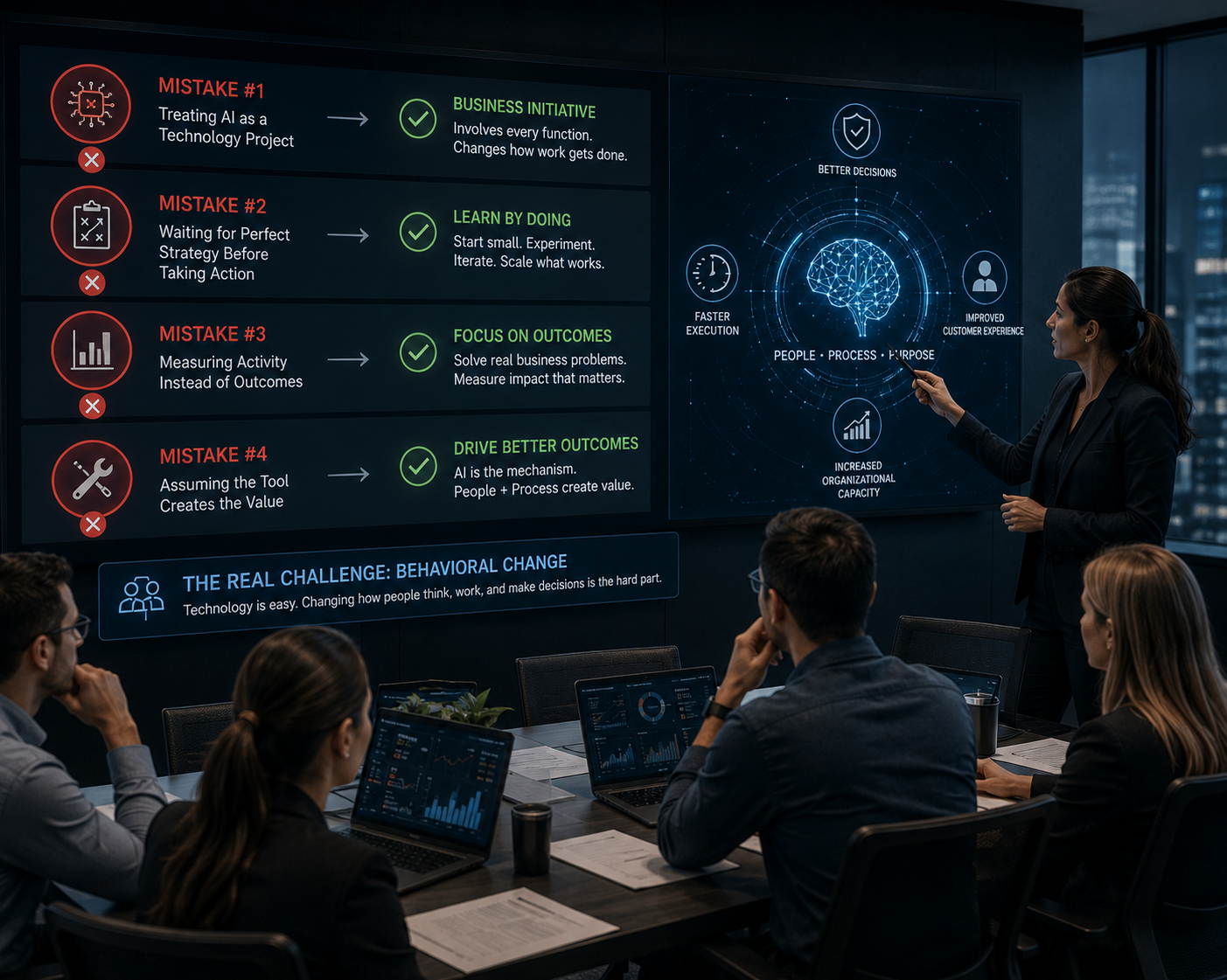
Mistake #1: Treating AI as a Technology Project
One of the most common leadership mistakes is treating AI as purely an IT initiative.
Organizations often hand AI responsibility to technical teams and assume progress will naturally follow. But AI does not create value simply because it has been deployed.
It creates value when it changes how work gets done.
That means AI adoption impacts:
- Operations teams
- Sales teams
- Finance departments
- Customer support functions
- Executive decision making
- Security and governance teams
AI is not just a technology initiative. It is an operational and business transformation initiative.
From a security perspective, this distinction matters significantly. If AI adoption is isolated within IT, organizations risk fragmented governance, inconsistent usage, and limited visibility into how AI is actually influencing workflows.
Practical Security Implementation Ideas:
- Include security, operations, legal, and business leaders in AI governance discussions
- Align AI policies with operational workflows rather than treating them as standalone technical controls
- Establish cross-functional ownership of AI adoption and oversight
Mistake #2: Waiting for Perfect Strategy Before Taking Action
Many organizations delay progress because they want complete certainty before moving forward.
They want:
- Comprehensive governance frameworks
- Fully documented use cases
- Formal training programs
- Detailed success metrics
- Long term roadmaps
before adoption begins.
Meanwhile, the organizations making the most progress are learning through controlled experimentation.
They start small.
They identify friction points.
They test practical solutions.
Then they scale what works.
This approach allows organizations to develop governance and operational understanding alongside adoption rather than attempting to predict every outcome in advance.
Practical Security Implementation Ideas:
- Begin with low risk AI use cases that provide measurable operational value
- Pilot approved AI tools within controlled teams or workflows
- Use early deployments to refine governance policies and oversight processes
Progress often comes from iterative learning, not perfect planning.
Mistake #3: Measuring Activity Instead of Outcomes
Another common mistake is focusing on AI usage metrics rather than business impact.
It is easy to measure:
- How many employees are using AI
- How often AI tools are accessed
- How many licenses have been deployed
Those metrics may indicate adoption activity, but they do not necessarily reflect value.
The more important question is:
What business problem improved?
Did proposal turnaround times decrease?
Did support tickets get resolved faster?
Did reporting require less manual effort?
Did security teams reduce alert fatigue or response time?
Outcome based metrics create clarity around where AI is actually delivering value.
Practical Security Implementation Ideas:
- Measure reductions in incident response time after AI assisted triage
- Track improvements in reporting efficiency or audit preparation
- Evaluate whether AI reduces repetitive manual analysis tasks
The focus should remain on operational outcomes, not usage volume alone.
Mistake #4: Assuming the Tool Creates the Value
AI tools by themselves do not create business value.
The value comes from what the organization achieves through them.
AI enables:
- Faster execution
- Better decision making
- Improved customer experiences
- Greater operational capacity
- Reduced process friction
The technology is simply the mechanism.
Organizations that focus exclusively on acquiring tools without redesigning workflows or changing behaviors often see limited results.
The Real Challenge Is Behavioral Change
The organizations making the most progress with AI are not necessarily the ones with the largest budgets or newest platforms.
They are the ones that understand adoption is fundamentally about behavior.
Technology is usually the easier part.
Changing how people work is harder.
Employees need clear expectations. Teams need visible examples of success. Leadership needs to reinforce new workflows consistently. Security teams need to enable safe adoption instead of creating unnecessary friction.
This is where long term advantage is created.
Final Thoughts
AI adoption is not simply a technology deployment challenge.
It is an organizational change challenge.
The companies that succeed will not be the ones that merely purchase AI tools.
They will be the ones that:
- Align AI with business workflows
- Encourage experimentation with clear guardrails
- Measure operational outcomes instead of activity
- Reinforce new behaviors consistently
Because the real opportunity with AI is not the technology itself.
It is the ability to work differently, faster, and more effectively.
FAQs: AI Adoption and Organizational Change
1. Why do many AI initiatives fail despite strong technology?
Because organizations often focus on tools instead of workflows, behaviors, and operational integration. Technology alone does not change how work gets done.
2. Should AI adoption be owned by IT or the business?
AI adoption should be cross-functional. IT and security teams play critical roles, but business units must also shape workflows, priorities, and operational outcomes.
3. What is the best way to start AI adoption safely?
Start with small, measurable use cases inside approved environments. Focus on solving clear operational problems while building governance and oversight alongside adoption.
Want to be the first to know when new blogs are published? Sign up for our newsletter and get the latest posts delivered straight to your inbox. From actionable insights to cutting-edge innovations, you'll gain the knowledge you need to drive your business forward.