When is the right time to transition from Unified Communications as a Service (UCaaS) to Contact Center as a Service (CCaaS)?
For years, employee headcount was a reasonable rule of thumb. UCaaS handled internal communications, collaboration and basic call queues, while CCaaS focused on customer interactions, agent performance and the overall customer experience.
Today, that distinction is becoming increasingly blurred.
Advancements in artificial intelligence (AI), automation and cloud communications are giving organizations more opportunities to improve customer engagement without necessarily investing in a dedicated contact center platform.
So, is the tipping point 20 agents? 50? 100?
The better question is how your organization needs to manage, measure and improve its customer interactions.
How AI Is Changing the UCaaS vs. CCaaS Landscape
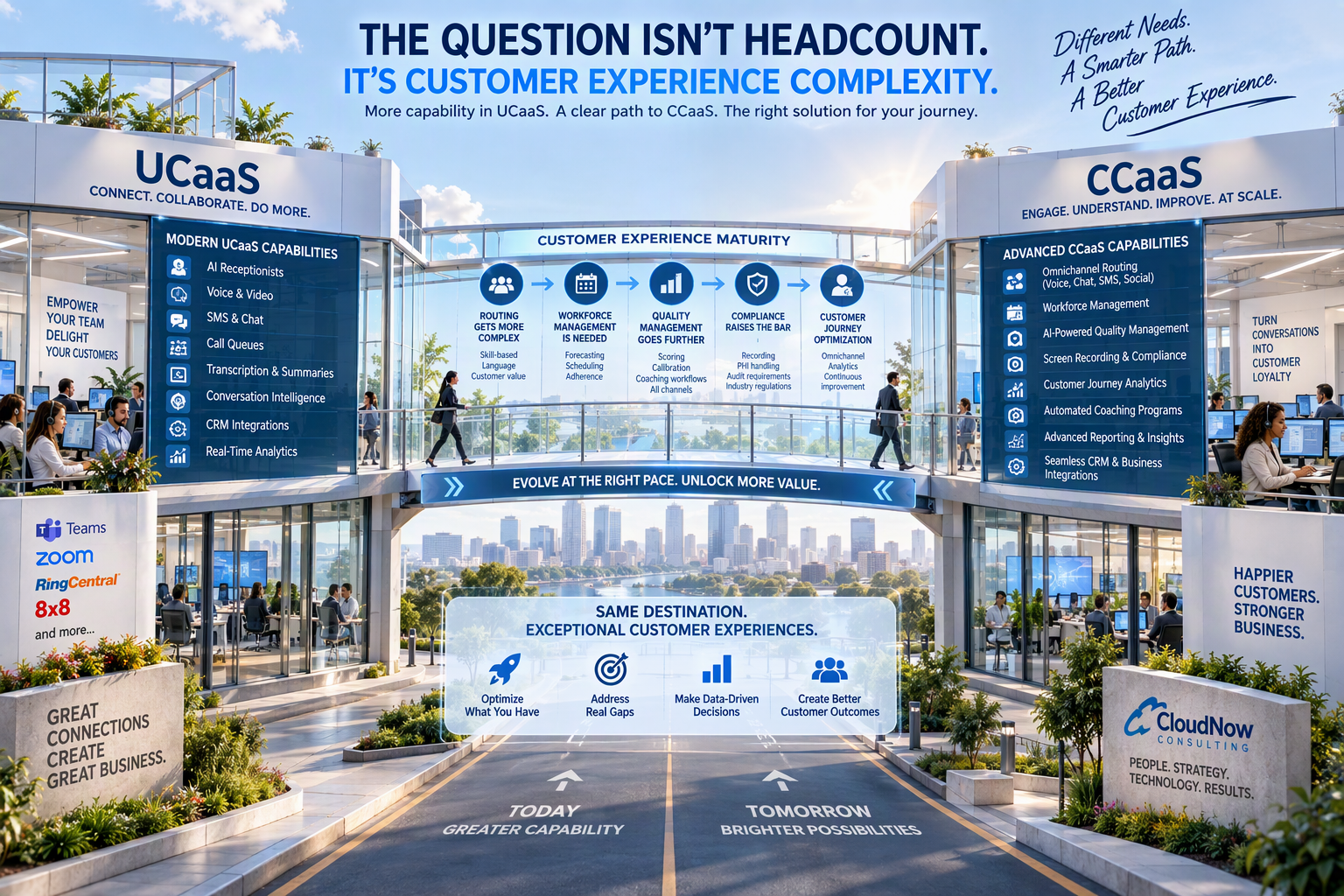
Cloud communications providers such as RingCentral, Microsoft Teams, Zoom and 8x8 are expanding their customer engagement capabilities. Many features that once required a dedicated contact center solution are now available within UCaaS platforms, through integrations or as premium add-ons.
Depending on your platform and licensing, these capabilities may include:
- AI receptionists and intelligent call routing
- Automated call transcription and conversation summaries
- AI-powered quality management and conversation intelligence
- CRM integrations and automated customer follow-up
- Real-time call queue analytics and reporting
- SMS and chat alongside voice
- AI-generated employee coaching recommendations
For smaller customer service teams, sales departments and healthcare organizations, these capabilities can significantly improve customer engagement without requiring a full contact center migration.
As AI continues to evolve, the gap between UCaaS and CCaaS will likely continue to narrow.
However, having access to individual contact center features is different from having the tools to manage a comprehensive contact center operation.
4 Signs Your Organization Has Outgrown UCaaS
In our experience working with organizations across industries, the decision to move to CCaaS is rarely driven by headcount alone. More often, it comes down to changing customer expectations, operational complexity and how customer-facing employees are measured and managed.
Here are four indicators that it may be time to consider a dedicated contact center solution.
1. Customer Interaction Routing Is Becoming More Complex
Traditional UCaaS call queues work well when customer inquiries can be distributed to the next available employee. However, as customer needs become more sophisticated, basic routing may no longer be enough.
Your organization may need to route interactions based on employee expertise, customer language preferences, account status, inquiry type or urgency.
For example, a healthcare organization may need to direct patients to different teams based on appointment scheduling, billing inquiries or specialized support. Sending every caller through a general queue can create unnecessary transfers, longer wait times and frustration.
Advanced contact center routing capabilities can help connect customers with the right resource more efficiently.
What your organization can do:
- Review existing call queue performance to identify frequent transfers, abandoned calls and routing inefficiencies.
- Map employee skills and customer inquiry types to determine whether your current platform can support more intelligent routing.
The objective is not simply to answer calls faster. It is to connect customers with the right person the first time.
2. Workforce Management Is Becoming a Priority
Managing employee schedules manually may work when customer interaction volumes are relatively predictable. As demand fluctuates, however, staffing becomes more challenging.
Longer customer wait times, inconsistent staffing levels, increased overtime and difficulty meeting service-level objectives are common signs that your organization needs a more structured approach to workforce management (WFM).
Dedicated contact center workforce management tools can help businesses forecast interaction volumes, optimize schedules and monitor employee adherence.
What your organization can do:
- Analyze historical interaction volumes, average handle times and peak demand periods to identify staffing trends.
- Align employee schedules with actual customer demand and evaluate workforce management tools when manual scheduling becomes difficult to maintain.
Effective workforce management helps organizations balance customer satisfaction, employee experience and operational costs.
3. Quality Management Needs Go Beyond AI Call Scoring
AI-powered quality management is one of the most valuable advancements in modern UCaaS platforms.
Organizations can now access tools that automatically score calls, analyze conversations and identify employee coaching opportunities. These capabilities can significantly improve visibility into customer interactions.
But scoring calls is one thing. Running a quality management program is another.
Dedicated contact center quality management (QM) solutions can provide more comprehensive capabilities, including:
- Customizable evaluation scorecards for different departments
- Automated interaction scoring across supported communication channels
- Quality calibration to ensure consistent evaluations
- Screen recording and desktop activity visibility
- Structured coaching workflows
- Employee performance improvement tracking
- Compliance-related interaction monitoring
In healthcare, for example, AI could help identify interactions where a required disclosure may have been missed or patient information may have been handled incorrectly. A comprehensive quality management solution can then support human review, documentation, coaching and corrective action.
What your organization can do:
- Develop department-specific quality scorecards that reflect customer experience, business processes and compliance requirements.
- Establish structured coaching workflows that track feedback, corrective actions and measurable performance improvements, with human oversight of AI-generated evaluations.
AI can help identify opportunities for improvement, but the processes built around those insights ultimately determine their value.
4. Compliance and Governance Requirements Are Increasing
For organizations in regulated industries, particularly healthcare and financial services, customer communications involve more than delivering a positive experience.
They also require appropriate safeguards for sensitive information, reliable documentation and visibility into potential compliance risks.
Depending on your organization's requirements, standard UCaaS functionality may not provide the necessary level of control over:
- Call recording and retention policies
- Protected health information (PHI)
- Sensitive financial and payment information
- Role-based access permissions
- Interaction reporting and audit trails
- Compliance monitoring and remediation workflows
A dedicated CCaaS solution may offer more advanced governance capabilities. However, implementing a contact center platform does not automatically guarantee regulatory compliance.
What your organization can do:
- Conduct a compliance gap assessment with your IT, security and compliance teams to identify limitations within your existing communications environment.
- Evaluate and test platform capabilities for recording controls, sensitive data protection, access management and audit reporting.
For some organizations, compliance requirements alone may justify a contact center migration, regardless of team size.
Before Migrating to CCaaS, Optimize Your Existing UCaaS Platform
Before beginning a contact center evaluation, take inventory of what your current communications platform already offers.
Many organizations are not fully utilizing the capabilities available within their existing UCaaS environment, especially as providers introduce new AI-powered features and customer engagement tools.
Consider the following questions:
- Are we fully utilizing the features included in our current licensing agreement?
- Can AI and automation address some of our existing operational challenges?
- Are our call queues and routing configurations optimized?
- Do supervisors have sufficient visibility into customer interactions and employee performance?
- Can available integrations or add-ons address our operational gaps?
- Does our current platform meet our security and compliance requirements?
- What is the actual cost of optimizing UCaaS compared with migrating to CCaaS?
Keep in mind that many advanced AI features are available through premium licensing tiers or paid add-ons. Some capabilities may already be included in your contract, while others may require additional investment.
Understanding the total cost of ownership, including licensing, implementation, integrations, training and ongoing support, will help you make a more informed technology decision.
Why a Phased Approach to Contact Center Transformation Makes Sense
Contact center transformation does not have to happen through one large technology initiative.
For many organizations, optimizing an existing UCaaS environment can be a more scalable and manageable first step. It can also help reduce short- and medium-term technology expenses while preparing employees for future changes.
A phased approach may include:
Phase 1: Optimize your existing UCaaS environment.
Review licensing, improve call routing, address reporting gaps and activate underutilized capabilities.
Phase 2: Introduce AI and automation.
Implement targeted capabilities such as AI receptionists, automated call summaries, conversation intelligence and quality management tools.
Phase 3: Identify operational gaps.
Evaluate whether your organization needs more advanced routing, workforce management, quality management or compliance capabilities.
Phase 4: Migrate to CCaaS when the business case supports it.
Select a contact center solution based on clearly defined operational requirements, measurable business objectives and long-term growth plans.
This approach allows organizations to modernize at a manageable pace while reducing implementation risks and addressing change management challenges.
After all, successful technology transformation is not just about implementing new tools. It is also about ensuring employees, supervisors and business leaders are prepared to use them effectively.
Making the Right Decision: UCaaS Optimization or CCaaS Migration?
There is no universal agent threshold that determines when an organization needs a dedicated contact center solution.
A team of 20 employees with complex routing, workforce management and compliance requirements may need CCaaS sooner than a team of 100 employees with relatively straightforward customer interactions.
The decision should be driven by business requirements, customer expectations and operational complexity rather than headcount alone.
If your existing UCaaS platform can support your current and near-term requirements, optimizing that investment may be the most practical and cost-effective approach.
If meaningful operational gaps remain, migrating to CCaaS may provide the foundation your organization needs to improve customer experience and support future growth.
How CloudNow Consulting Can Help
At CloudNow Consulting, we believe the right technology decision starts with understanding your business requirements, not selecting a new platform.
Before you evaluate a contact center solution, we help you understand what your current UCaaS platform can already handle, identify operational gaps and determine whether those gaps justify a new technology investment.
Sometimes, the answer is to turn on what you are already paying for. Sometimes, it is a targeted upgrade. And sometimes, a dedicated CCaaS solution is the right next step.
Our goal is to help you make an informed decision that aligns with your customer experience objectives, operational needs, budget and long-term technology strategy.
Ready to evaluate your UCaaS capabilities or explore a contact center migration? Contact CloudNow Consulting to develop a technology roadmap that supports your organization's needs today and prepares you for tomorrow.
Frequently Asked Questions
How many agents do you need before moving to a contact center solution?
There is no minimum number of agents required to justify a dedicated contact center solution. Organizations should evaluate customer interaction complexity, routing requirements, workforce management, quality management and compliance needs rather than relying solely on employee headcount.
Even a small customer service team may benefit from CCaaS if its operational requirements exceed the capabilities of its existing UCaaS platform.
Can AI-powered UCaaS replace a traditional contact center solution?
AI-powered UCaaS platforms can support many customer engagement functions, including intelligent call routing, automated transcription, conversation analytics and quality scoring.
However, organizations that require advanced omnichannel routing, workforce management, comprehensive quality programs and sophisticated governance controls may still benefit from a dedicated CCaaS platform.
The right solution depends on the complexity of your contact center operations and business requirements.
How can contact centers determine whether a CCaaS migration is worth the investment?
Start by conducting a gap assessment of your existing communications environment. Evaluate customer wait times, call transfer rates, staffing efficiency, quality management processes, compliance requirements and available platform capabilities.
Compare the total cost of optimizing your existing UCaaS platform with the cost of implementing CCaaS. A migration should address measurable operational challenges, improve customer experience and deliver meaningful business value.
Want to be the first to know when new blogs are published? Sign up for our newsletter and get the latest posts delivered straight to your inbox. From actionable insights to cutting-edge innovations, you'll gain the knowledge you need to drive your business forward.