
The Best AI Model Is Not Always the Most Powerful
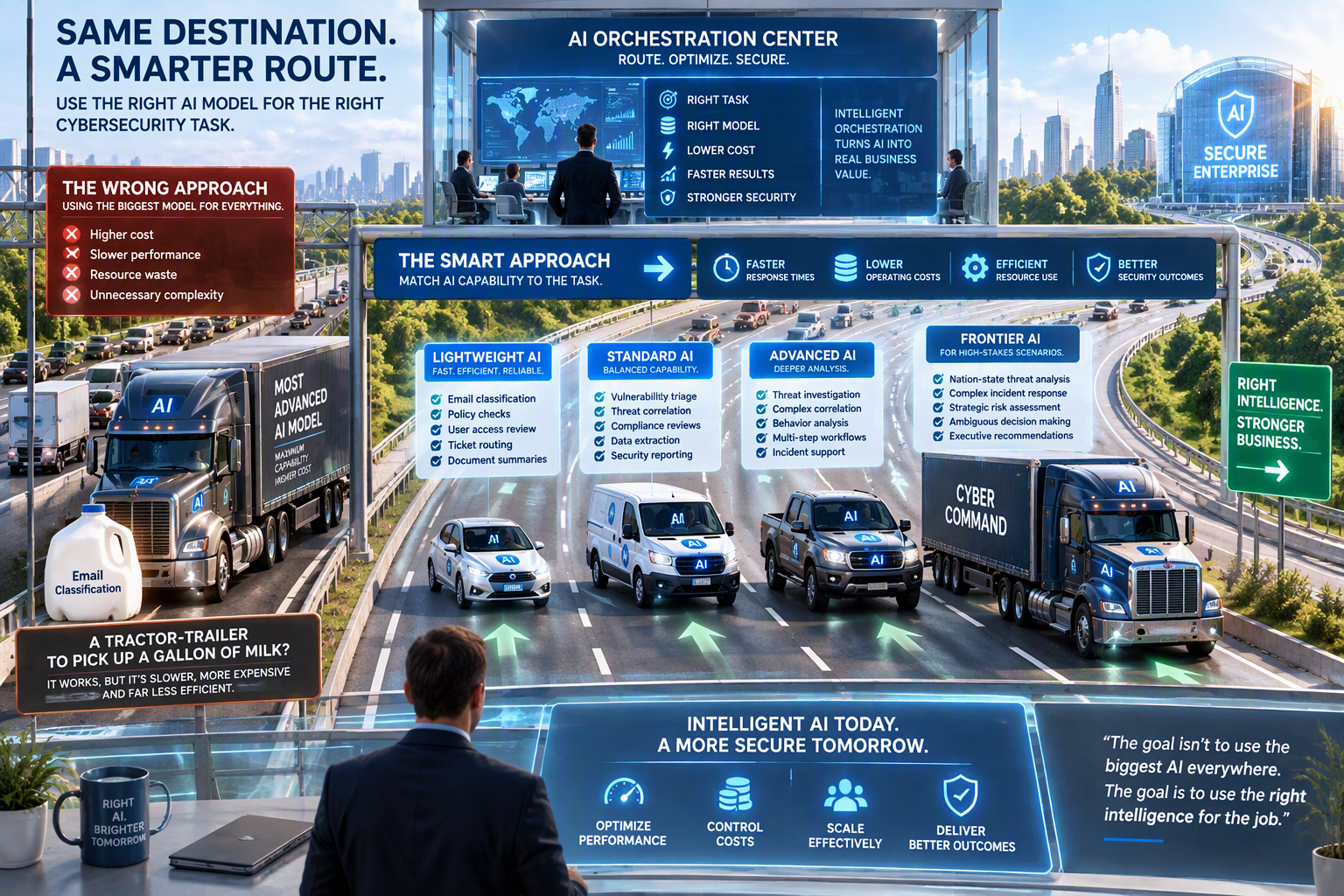
Imagine using a tractor-trailer to pick up a gallon of milk.
It would certainly get the job done.
But it would also be slower, more expensive, and far less efficient than simply driving a car.
That is a useful way to think about artificial intelligence.
Over the last few years, much of the AI conversation has focused on which model is the smartest, fastest, or most capable.
Which model performs best on benchmarks?
Which one can handle the most complex reasoning?
Which one has the largest context window?
Those questions matter, but as AI becomes embedded in everyday business operations, another question becomes increasingly important.
How much intelligence does this particular task actually require?
The organizations that get the most value from AI may not be the ones using the most advanced models everywhere.
They may be the ones that know when advanced capabilities are necessary and when simpler technology can deliver the same result.
Why AI Model Selection Matters for Enterprise Productivity
AI models vary significantly in capability, speed, cost, and resource requirements.
Some models are designed for complex reasoning, sophisticated analysis, and difficult problem solving.
Others are optimized for speed, efficiency, and routine tasks.
Both have a place in an enterprise AI strategy.
The challenge is matching the right model to the right workload.
Consider two examples.
An organization is using AI to evaluate a complex business decision involving financial risk, regulatory requirements, and several competing strategic options.
That task may justify a highly capable reasoning model because the quality of the analysis matters more than a relatively small difference in processing cost.
Now consider an AI system that categorizes incoming emails according to a predefined set of labels.
That task may be handled effectively by a smaller, faster, and less expensive model.
Using the same advanced model for both activities may produce acceptable results.
But it may not be the most efficient approach.
The goal should not be to maximize intelligence at every step.
It should be to apply the appropriate level of capability to the work being performed.
More Intelligence Does Not Automatically Create More Value
One of the easiest mistakes organizations can make is assuming that a more capable AI model will always produce a better business outcome.
That is not necessarily true.
For complex analysis, the additional reasoning capabilities of an advanced model may significantly improve the result.
For routine classification or information extraction, a simpler model may perform just as well.
In those situations, paying for additional capability may not create additional value.
It can also introduce unnecessary latency.
An employee waiting for a routine request to be processed may care much more about receiving a correct answer in two seconds than receiving an equally correct answer in ten.
This changes how organizations should evaluate AI performance.
Instead of asking which model is best overall, leaders should ask:
- Does the model meet the accuracy requirements of the task?
- How quickly does it complete the work?
- What does each successful execution cost?
- How consistently does it perform?
- Does the task require advanced reasoning?
- What are the consequences if the model makes a mistake?
These questions create a more practical foundation for AI model selection.
Different AI Tasks Require Different Levels of Capability
Enterprise AI workloads generally fall into several categories.
Routine Classification and Information Extraction
These tasks often involve identifying information, applying known categories, or extracting specific details.
Examples include:
- Categorizing incoming support requests
- Extracting invoice numbers from documents
- Identifying predefined information in forms
- Routing internal service requests
- Tagging documents based on established criteria
These activities may be suitable for smaller models or, in some cases, traditional software rules.
Practical implementation: Test a smaller model against a representative sample of real business data and measure accuracy before deploying it.
Practical implementation: Use confidence thresholds to send uncertain results to a more capable model or a human reviewer.
Summarization and Content Processing
Other tasks involve summarizing documents, organizing information, or transforming content into a standard format.
Examples include:
- Summarizing routine meeting notes
- Creating structured reports from existing data
- Preparing internal knowledge summaries
- Converting unstructured text into standardized records
Some of these tasks can be handled efficiently by smaller models.
Others may require more advanced capabilities, particularly when the source material is complex or accuracy requirements are high.
Practical implementation: Establish output quality standards and compare model performance against those standards.
Practical implementation: Use simpler models for routine summaries while reserving advanced models for complex, sensitive, or high-impact analysis.
Complex Reasoning and Decision Support
Certain tasks require deeper analysis, interpretation, and judgment.
Examples include:
- Evaluating competing strategic options
- Analyzing complicated security incidents
- Assessing business risks
- Developing technical architectures
- Interpreting ambiguous information
- Supporting consequential decisions
These workloads may justify more capable models.
However, even advanced AI outputs require appropriate validation and human accountability.
Practical implementation: Identify tasks where improved reasoning quality creates measurable business value.
Practical implementation: Establish human review requirements for recommendations involving significant financial, operational, security, or regulatory consequences.
The objective is not to use smaller models everywhere.
It is to use advanced models where their capabilities make a meaningful difference.
Agentic AI Makes Model Selection Even More Important
The economics become more interesting as organizations adopt agentic AI.
A traditional generative AI interaction may involve one request and one response.
An AI agent can execute many steps to complete a single objective.
For example, an agent preparing a business report might:
- Retrieve information from several systems.
- Classify the information.
- Extract relevant details.
- Summarize supporting documents.
- Identify inconsistencies.
- Analyze the findings.
- Generate recommendations.
- Verify the final output.
Each step may require a different level of capability.
There is no reason every step must use the same model.
A smaller model may be sufficient for classification and extraction.
A more capable model may be appropriate for complex analysis.
A separate validation process may be needed to confirm that the final output meets the required standard.
This approach is often called AI model routing, where different requests or workflow steps are directed to models based on their requirements.
When implemented effectively, model routing can reduce costs and improve performance without compromising the quality of the overall workflow.
AI Model Routing Can Improve Workflow Economics
Consider an agentic workflow that executes twenty AI operations to complete one business task.
If every operation uses an expensive reasoning model, the total cost may be substantially higher than necessary.
Now imagine that fifteen of those operations involve routine classification, extraction, or summarization.
Those steps may be suitable for a smaller model.
The remaining five operations may require deeper reasoning.
By selecting models based on the needs of each step, the organization may reduce overall consumption while maintaining the required quality.
The savings from one workflow may appear modest.
But when that workflow executes thousands or millions of times, the economics can become significant.
Practical Enterprise Implementation Ideas
1. Break workflows into individual capabilities.
Document each step of an AI workflow and identify whether it requires routine processing, information retrieval, summarization, or complex reasoning.
Use those requirements to guide model selection.
2. Establish model routing and escalation rules.
Direct routine activities to appropriately capable models.
Escalate complex, uncertain, or high-impact tasks to more capable models or human reviewers.
This creates a more deliberate approach to AI consumption.
Security Teams Can Benefit From Smarter Model Selection
Cybersecurity provides a particularly useful example.
Security operations involve a combination of repetitive information processing and complex analytical work.
Some activities are relatively straightforward.
Others require significant contextual understanding and careful judgment.
Using the same AI model for every security task may be unnecessarily expensive.
It may also introduce avoidable delays.
Routine Security Tasks
Smaller models may be suitable for activities such as:
- Categorizing security tickets
- Extracting indicators from reports
- Summarizing routine alerts
- Organizing vulnerability information
- Standardizing incident documentation
- Identifying missing fields in security records
These activities can consume considerable analyst time without necessarily requiring advanced reasoning.
Complex Security Tasks
More capable models may be appropriate for:
- Correlating evidence across multiple security systems
- Analyzing ambiguous incident activity
- Evaluating competing threat hypotheses
- Assessing complex attack paths
- Supporting security architecture decisions
- Developing detailed incident response recommendations
These activities require deeper analysis and may involve greater consequences if the output is inaccurate.
Practical Security Implementation Ideas
1. Separate security data processing from security decision support.
Use efficient models for repetitive tasks such as enrichment, categorization, and documentation.
Reserve advanced models for investigations and analytical work that genuinely require deeper reasoning.
2. Evaluate model performance against security outcomes.
Measure investigation quality, false positive rates, processing time, and analyst review requirements.
Do not assume that a smaller model is appropriate simply because a task appears repetitive.
The model must still meet the organization's security and accuracy requirements.
Model Selection Is Also an AI Governance Decision
Choosing an AI model is not purely a financial or technical decision.
It also has security, privacy, and compliance implications.
Different models and providers may offer different capabilities for:
- Data protection
- Access control
- Logging and monitoring
- Data retention
- Deployment environments
- Regulatory compliance
- Enterprise integration
An inexpensive model is not necessarily the right choice if it cannot meet the organization's security requirements.
Likewise, a highly capable model should not automatically receive access to sensitive information simply because it performs well.
Organizations need to evaluate model suitability across multiple dimensions.
Practical Security Implementation Ideas
1. Create an approved model catalog.
Maintain a list of AI models approved for specific categories of work.
Document their permitted data classifications, security requirements, intended use cases, and operational limitations.
2. Apply consistent governance across models.
Ensure that switching between models does not bypass data protection rules, access restrictions, monitoring, or human approval requirements.
Model routing should improve efficiency without creating security gaps.
The Cheapest Model Is Not Always the Most Economical
There is an important distinction between minimizing model cost and optimizing workflow cost.
A smaller model may cost less per request.
But if it produces inaccurate results, requires repeated attempts, or creates additional human review, the overall workflow may become more expensive.
A more capable model might complete the task correctly on the first attempt.
In that situation, the higher individual model cost could be justified.
Organizations should therefore evaluate total workflow economics rather than focusing exclusively on token pricing.
Useful measures include:
- Cost per successful workflow
- Accuracy and output quality
- Processing time
- Retry frequency
- Human review requirements
- Error correction costs
- Business or security impact
The objective is not to select the cheapest model.
It is to select the most efficient approach that reliably meets the required standard.
AI Optimization Will Become an Ongoing Management Discipline
As AI becomes embedded in more business processes, model selection will need to evolve.
New models will become available.
Pricing structures will change.
Existing models may improve.
Business requirements will shift.
A model that represents the best choice today may not remain the best option indefinitely.
Organizations should periodically reevaluate their AI workloads.
This does not require replacing models every time a new release appears.
It requires establishing a disciplined process for comparing cost, quality, performance, and risk.
Practical Enterprise Implementation Ideas
1. Benchmark models against real workloads.
Use representative business scenarios rather than relying exclusively on general model rankings.
2. Review model efficiency regularly.
Monitor workflow costs, quality, latency, and failure rates to identify opportunities for improvement.
Over time, this discipline can become an important part of enterprise AI operations.
Final Thoughts
Back to the tractor-trailer.
The goal is not to own the biggest vehicle.
The goal is to use the right vehicle for the trip.
AI is moving in the same direction.
As organizations deploy more generative and agentic AI workflows, the most important question will not always be which model has the greatest capabilities.
It will be which model provides the capabilities the work actually requires.
Sometimes that will be the most advanced model available.
Other times, a smaller and less expensive model will deliver the same result more efficiently.
The smartest AI strategy may not be using the smartest model everywhere.
It may be knowing where advanced intelligence creates real value and where it is simply unnecessary overhead.
FAQs: AI Model Selection, Cost Optimization, and Security
1. How can organizations determine which AI model is appropriate for a specific task?
Organizations should evaluate the complexity of the task, required accuracy, acceptable processing time, security requirements, and consequences of an incorrect result. Testing multiple models against representative workloads can help identify the most cost-effective option that meets the required performance standards.
2. Can smaller AI models be used safely for cybersecurity tasks?
Yes, when they are appropriately evaluated and deployed within established security controls. Smaller models may be effective for routine activities such as ticket classification, information extraction, and documentation. More complex investigations or consequential security decisions may require more capable models and human oversight.
3. How does AI model routing help reduce agentic AI costs?
AI model routing directs different workflow steps to models based on their requirements. Routine tasks can use smaller, less expensive models, while complex reasoning tasks can use more capable models. This approach can reduce unnecessary consumption, improve processing speed, and maintain output quality when supported by appropriate testing and governance.
Want to be the first to know when new blogs are published? Sign up for our newsletter and get the latest posts delivered straight to your inbox. From actionable insights to cutting-edge innovations, you'll gain the knowledge you need to drive your business forward.