Organizations Were Built Around Human Limitations
For decades, businesses were designed around the natural limitations of human work.
Information moved at the pace people could process it.
Decisions waited for meetings and approvals.
Reporting waited for analysis.
Customer service depended on staff availability.
That was not inefficient by design. It was simply how organizations operated.
AI is beginning to change those assumptions.
Not because people matter less, but because the mechanics of work itself are evolving.
Information moves faster.
Analysis happens faster.
Content is generated faster.
Decisions can occur with far less delay between question and answer.
As that acceleration increases, organizations eventually need to redesign around it.
Why Layering AI on Top of Old Workflows Eventually Fails
Many organizations are still approaching AI as an add on.
They introduce tools while leaving underlying workflows unchanged.
At first, this creates productivity improvements. But over time, the limitations become obvious.
Because AI is not just another productivity tool.
It changes the operating rhythm of the business.
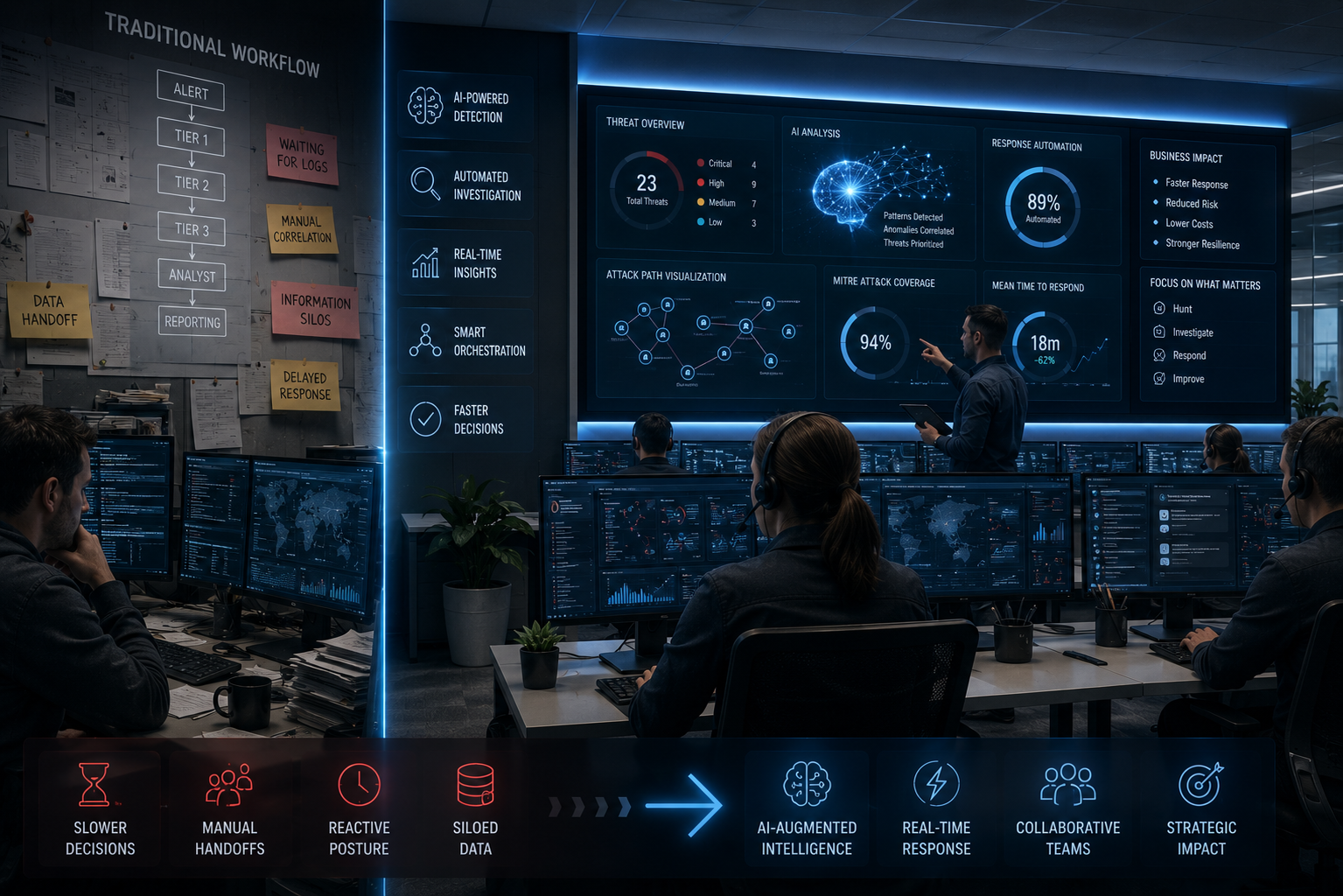
When workflows remain dependent on old approval chains, manual handoffs, and fragmented systems, the benefits of AI become constrained. Speed increases in isolated areas, but the organization itself still moves at the pace of the old model.
From a security perspective, this can create additional friction and risk. Teams may adopt AI driven processes while governance, oversight, and operational structures remain disconnected.
What Changes in an AI-Driven Operating Model
As organizations mature in their AI adoption, the nature of work begins to shift.
Repetitive work decreases dramatically.
Teams spend less time gathering information and more time interpreting it.
Managers spend less time collecting updates and more time guiding decisions.
Employees increasingly orchestrate systems rather than manually process tasks.
The value of work moves upward.
Judgment becomes more important.
Communication becomes more important.
Context becomes more important.
This does not eliminate the need for people. It changes where human value is concentrated.
AI Reduces Friction Across the Organization
One of the biggest operational changes AI introduces is the reduction of friction.
Organizations become less dependent on delays that previously felt unavoidable.
There are fewer bottlenecks.
Fewer repetitive handoffs.
Less waiting for someone to manually transfer information between systems.
That changes expectations internally and externally.
Customers expect faster responses.
Employees expect faster access to information.
Leadership expects faster insight and decision support.
The result is a fundamentally different kind of organization.
Not necessarily smaller.
Not necessarily less human.
But significantly faster and more adaptive.
The Security Implications of an AI-Driven Operating Model
As operating speed increases, security and governance models must evolve alongside it.
Traditional review cycles and manual oversight processes may become too slow for AI accelerated environments.
Security teams will need to shift toward:
- Real time monitoring and policy enforcement
- Automated governance controls
- Continuous visibility into AI assisted workflows
- Faster escalation and decision frameworks
Practical Security Implementation Ideas:
- Integrate AI governance directly into operational workflows instead of treating it as a separate review process
- Automate monitoring of AI generated outputs tied to sensitive systems or data
- Establish risk based approval thresholds for AI driven actions
- Redesign incident response workflows to align with faster operational tempos
Organizations that fail to modernize governance alongside operations may struggle to balance speed with control.
This Is Bigger Than Automation
The long term impact of AI is not simply task automation.
It is operational redesign.
Every major technology shift eventually changes how organizations function at a structural level. AI is no different.
The organizations gaining the greatest advantage will not just deploy AI tools.
They will rethink how work flows across the business.
They will redesign processes around accelerated information movement, faster decision cycles, and reduced operational friction.
That is where the real transformation occurs.
Final Thoughts
AI is reshaping the operating model of modern organizations.
It is changing how information moves, how decisions happen, and where human value is applied.
The future will not belong to organizations that simply layer AI onto outdated systems.
It will belong to organizations willing to redesign how work happens altogether.
Because every major technology shift eventually creates a new operating model.
And many organizations are closer to that shift than they realize.
FAQs: AI Operating Models and Security
1. What is an AI-driven operating model?
An AI-driven operating model is a way of organizing work where AI accelerates information flow, decision making, and repetitive processes, allowing teams to focus more on judgment and strategy.
2. Why can’t organizations simply add AI to existing workflows?
Because legacy workflows often contain delays, manual handoffs, and approval structures that limit the speed and value AI can provide. Long term gains require operational redesign.
3. How should security teams adapt to AI-driven operating models?
Security teams should move toward continuous monitoring, automated governance, and risk based oversight that can operate at the speed of AI accelerated workflows.
Want to be the first to know when new blogs are published? Sign up for our newsletter and get the latest posts delivered straight to your inbox. From actionable insights to cutting-edge innovations, you'll gain the knowledge you need to drive your business forward.