AI Productivity Is About More Than Saving Time
Imagine upgrading a factory so that one machine can complete in one hour what previously took three.
You would probably celebrate the efficiency improvement.
But the real business value would depend on what happens with the two hours you just created.
Does the factory increase production?
Improve quality?
Take on new orders?
Reduce operational costs?
Or does that additional capacity simply go unused?
AI is creating the same question for knowledge work.
Much of the conversation around enterprise AI focuses on how much time the technology can save. Employees can draft documents faster, analyze information more efficiently, automate repetitive activities, and complete complex workflows with less manual effort.
These are meaningful improvements.
But time saved is not automatically value created.
The real question is what happens next.
Why AI Time Savings Do Not Always Translate Into Business Value
Imagine an employee who saves five hours every week by using AI.
They spend less time preparing reports, summarizing meetings, researching information, and completing administrative work.
On paper, that represents a significant productivity improvement.
But what happens to those five hours?
If they are absorbed by additional meetings, more emails, unnecessary reporting, or other low-value activities, the organization may see very little meaningful benefit.
The technology has delivered an efficiency gain.
The organization has failed to convert it into productive capacity.
This is an important distinction for leaders evaluating AI investments.
Measuring how much faster employees complete individual tasks provides useful information, but it does not necessarily explain whether the business is performing better.
AI productivity should be measured not only by the effort eliminated but also by the opportunities that elimination creates.
Human Time Returned: A Better AI Productivity Metric
One of the most meaningful metrics for enterprise AI may be human time returned.
Human time returned measures the amount of employee time recovered through AI adoption after accounting for the additional work required to use, review, and manage the technology.
But the measurement should not stop there.
Organizations also need to understand where that recovered time goes.
There are three important dimensions to consider:
Time recovered: How much manual effort has AI eliminated from an existing process?
Capacity redirected: How much of that recovered time has been intentionally allocated to more valuable activities?
Value realized: What measurable improvements have resulted from that additional capacity?
Together, these dimensions provide a more complete picture of AI productivity.
They connect technology performance with workforce effectiveness and business outcomes.
Practical Enterprise Implementation Ideas
1. Establish a baseline for employee effort. Measure how much time employees spend completing representative workflows before introducing AI. Include preparation, execution, review, and rework.
2. Create a capacity allocation plan. Identify where recovered employee time should be directed before implementing AI. This helps prevent productivity gains from being absorbed by existing organizational inefficiencies.
How to Measure Human Time Returned
Organizations can begin with a relatively simple calculation.
Human time returned = Original human effort minus remaining human effort after AI implementation
The calculation should account for the full workflow, including any additional time required for prompting, validating outputs, correcting mistakes, and handling exceptions.
Consider a hypothetical business team with 50 employees.
Each employee recovers an average of five hours per week through effective AI adoption.
That represents 250 hours of additional workforce capacity every week.
Over 48 working weeks, the organization could recover approximately 12,000 hours of human time.
Based on a 40-hour working week, that is equivalent to the annual working capacity of approximately six full-time employees over the same 48-week period.
That does not mean the organization should eliminate six positions.
It means the organization has potentially created additional capacity without increasing its existing workforce.
The important question is what the business can accomplish with those 12,000 hours.
Can it serve more customers?
Complete strategic projects that have been delayed?
Improve operational quality?
Strengthen security?
Support growth without increasing headcount at the same rate?
These are the outcomes that determine whether the AI investment creates meaningful value.
Redirect AI Capacity Toward Higher-Value Work
Different employees and departments will have different opportunities to benefit from recovered time.
A salesperson may benefit from spending less time preparing proposals and more time developing customer relationships.
A manager may spend less time compiling reports and more time coaching employees.
A financial analyst may spend less time gathering information and more time evaluating business performance.
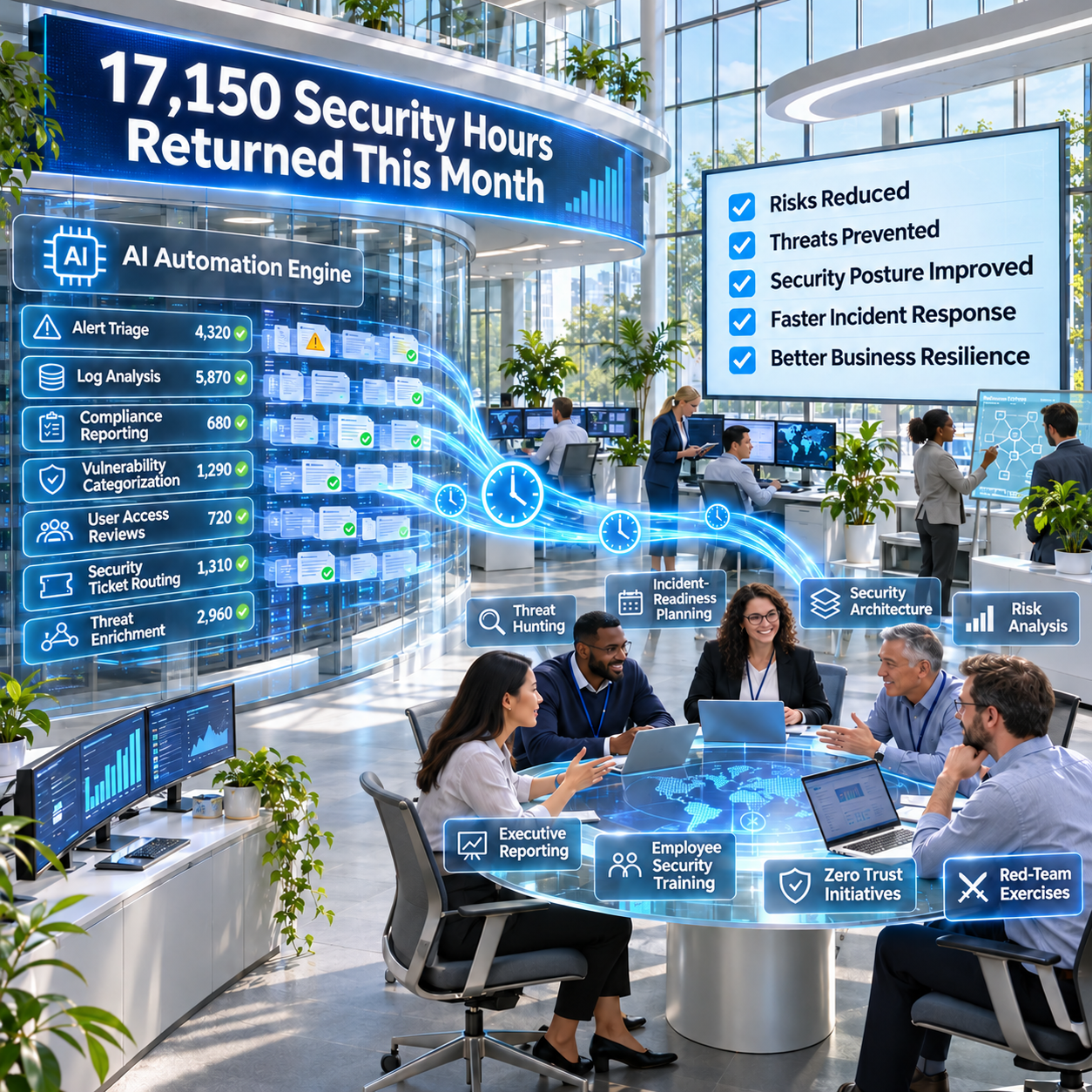
A cybersecurity analyst may spend less time manually enriching alerts and more time investigating sophisticated threats.
The value of AI is not necessarily that employees can complete more tasks.
It may be that employees can spend more time doing the work that matters most.
Organizations should consider redirecting recovered capacity toward activities such as:
- Customer engagement and relationship development
- Strategic planning and complex problem solving
- Employee coaching and professional development
- Product and service innovation
- Process improvement and quality assurance
- Cybersecurity and organizational resilience
- Projects previously delayed by resource constraints
These activities often create substantial value but struggle to receive sufficient attention because routine operational demands consume so much employee time.
AI creates an opportunity to change that balance.
Practical Enterprise Implementation Ideas
1. Identify neglected high-value activities. Ask department leaders which important initiatives consistently receive insufficient attention because their teams are occupied with routine work.
2. Protect recovered capacity. Allocate dedicated time for strategic projects, professional development, customer engagement, or other priorities rather than allowing every available hour to be absorbed by additional administrative work.
What Human Time Returned Means for Cybersecurity Teams
Cybersecurity provides a particularly useful example of why this metric matters.
Security teams frequently operate under significant resource constraints.
Analysts may spend substantial amounts of time reviewing alerts, gathering evidence, preparing reports, managing vulnerabilities, and responding to routine security requests.
These activities are necessary, but they can limit the time available for proactive security work.
AI can help reduce the manual effort associated with activities such as:
- Security alert enrichment
- Incident documentation
- Threat intelligence summarization
- Vulnerability information gathering
- Compliance evidence collection
- Routine security reporting
- Security service request classification
The immediate benefit is reduced manual effort.
The greater opportunity is what security teams can do with the recovered time.
Instead of simply processing more alerts, analysts could allocate more capacity toward threat hunting, improving detection capabilities, strengthening security architecture, testing incident response procedures, and addressing underlying sources of risk.
This is where AI productivity can translate into better security outcomes.
Practical Security Implementation Ideas
1. Reinvest analyst capacity into proactive security. Identify repetitive security operations that can be safely accelerated with AI and establish specific plans to redirect recovered analyst time toward threat hunting, detection engineering, and risk reduction.
2. Measure security improvements alongside time savings. Evaluate whether recovered capacity leads to faster investigations, better detection coverage, reduced vulnerability exposure, improved incident preparedness, or stronger security controls.
Saving analyst time is valuable.
Using that time to improve the organization's security posture is potentially more valuable.
AI Governance Should Account for the Human Effort Still Required
Not every AI workflow will return as much human time as organizations initially expect.
Some AI systems require substantial human oversight.
Employees may need to validate information, correct inaccurate outputs, monitor automated actions, or resolve exceptions.
Agentic AI can introduce additional operational requirements related to permissions, monitoring, security, and accountability.
These activities must be included when calculating productivity improvements.
For example, an AI workflow might eliminate two hours of manual processing but introduce thirty minutes of validation and exception handling.
The net human time returned is ninety minutes, not two hours.
That distinction matters when organizations calculate AI ROI.
It also prevents leaders from creating pressure to remove necessary security or quality controls simply to achieve more impressive productivity figures.
Practical Security Implementation Ideas
1. Measure net time savings across the entire workflow. Include human review, security validation, monitoring, troubleshooting, and exception handling when evaluating AI productivity.
2. Maintain risk-based oversight. Preserve appropriate human review for activities involving sensitive information, privileged access, regulatory obligations, or consequential business decisions.
The objective is not to eliminate human involvement everywhere.
It is to reduce unnecessary human effort while protecting the quality and security of the result.
AI Productivity Should Not Become a Workload Penalty
AI also creates an important leadership challenge.
What happens when employees become significantly more productive?
One response is to immediately assign them more work.
If an employee can complete ten reports in the time previously required to complete five, the organization might simply expect ten reports every week.
But are ten reports actually needed?
If every efficiency improvement automatically results in a larger workload, employees may begin to associate AI adoption with increased pressure rather than improved working conditions.
That can create unintended consequences.
Employees may become less willing to share productivity improvements, experiment with AI, or identify opportunities for automation.
Organizations could end up discouraging the behavior they want to promote.
A better approach is to make intentional decisions about where recovered capacity goes.
Sometimes that will mean increasing output.
Sometimes it will mean improving quality.
Sometimes it will mean giving employees more space to think, learn, collaborate, or solve difficult problems.
It may also mean reducing unsustainable workloads and improving employee well-being.
Productivity improvements should create opportunities for both the organization and its people.
Practical Leadership Implementation Ideas
1. Reward outcomes rather than additional activity. Evaluate employees based on the quality, impact, and value of their work instead of continually increasing task volumes as AI makes individual activities faster.
2. Involve employees in capacity planning. Ask employees where recovered time could be most effectively used. The people performing the work often understand which important activities have been neglected.
Human Time Returned Can Support Business Growth Without Proportional Headcount Growth
One of the most significant economic opportunities created by AI may be the ability to expand business capacity without increasing headcount at the same rate.
As organizations grow, they typically need additional employees to manage increasing operational demands.
More customers create more service requirements.
More transactions create more administrative work.
More technology creates more security and governance responsibilities.
AI can potentially change that relationship.
If existing teams can manage greater business volume while maintaining quality, security, and sustainable workloads, organizations may be able to grow more efficiently.
That does not necessarily mean reducing the workforce.
It may mean existing employees can support a larger business without requiring a proportional increase in staffing.
This can create economic value through:
- Reduced future hiring requirements where capacity genuinely increases
- Greater operational scalability
- Increased revenue-generating capacity
- Improved customer service
- Faster completion of strategic initiatives
- Reduced dependence on overtime or external resources
However, recovered employee time should not automatically be recorded as financial savings.
Organizations need to distinguish between available capacity, avoided future expenses, realized cost reductions, and additional business value.
Each represents a different type of return on investment.
AI ROI Dashboards Should Track Where Human Time Goes
As organizations mature in their use of AI, traditional adoption dashboards will become less sufficient.
Knowing how many employees have access to AI or how frequently they use it does not explain whether workforce capacity is improving.
A more meaningful AI productivity dashboard should answer several questions.
How much human time has AI returned?
Measure the net reduction in employee effort across individual tasks and completed workflows.
Where has that time been redirected?
Identify how much recovered capacity has been allocated to customer engagement, strategic work, innovation, security, or other business priorities.
Has workflow quality improved?
Evaluate accuracy, consistency, error rates, and customer outcomes to confirm that efficiency gains are not compromising quality.
Has operational capacity increased?
Determine whether existing teams can support greater business volume without unsustainable increases in workload.
Have security and compliance requirements been maintained?
Confirm that productivity improvements have not come at the expense of appropriate human oversight, data protection, or risk management.
What measurable business value has been created?
Connect recovered employee capacity with financial benefits, improved service, increased revenue, risk reduction, or other meaningful organizational outcomes.
These measurements create a stronger foundation for understanding AI ROI than tracking time savings alone.
Human Time Returned Is Ultimately a Management Responsibility
AI can help create additional capacity.
But technology cannot determine every strategic priority for how that capacity should be used.
That remains a leadership responsibility.
Business leaders need to identify where additional human effort creates the greatest value.
Finance teams need to distinguish theoretical productivity improvements from actual economic benefits.
Managers need to redesign workloads and performance expectations.
Security teams need to ensure efficiency does not compromise necessary controls.
Employees need opportunities to apply their judgment, experience, and creativity to more meaningful work.
This is why AI productivity is not simply a technology challenge.
It is also a management and organizational design challenge.
Companies that fail to rethink how work is allocated may introduce powerful AI capabilities without realizing their full potential.
Final Thoughts
Back to the factory.
The important metric is not simply how much faster the machine became.
It is what the business was able to accomplish with the capacity that improvement created.
AI should be measured the same way.
The organizations that benefit most from AI will not necessarily be those reporting the largest number of hours saved.
They may be the ones that are most intentional about what happens with those hours.
They will redirect human capacity toward customers.
Toward innovation.
Toward deeper analysis and better decisions.
Toward employee development.
Toward stronger security and organizational resilience.
And toward work that creates meaningful business value.
Time saved tells you the technology worked.
What you do with that time tells you whether the investment mattered.
If AI gave your organization 10% of its employees' time back tomorrow, where would you want that capacity to go?
FAQs: AI Productivity, Human Time Returned, and Enterprise Security
1. How can organizations measure human time returned through AI adoption?
Organizations should compare the employee effort required to complete workflows before and after AI implementation. The calculation should account for remaining human review, validation, exception handling, and governance activities. Leaders should then track how recovered capacity is redirected and what measurable business or security outcomes result.
2. How can cybersecurity teams turn AI time savings into meaningful security improvements?
Cybersecurity teams can use AI to reduce repetitive work such as alert enrichment, evidence gathering, incident documentation, and routine reporting. Recovered analyst capacity can then be redirected toward threat hunting, detection engineering, vulnerability remediation, security architecture, and incident response preparedness. Improvements should be measured through security outcomes rather than activity volume alone.
3. Can AI reduce cybersecurity operating costs without compromising security?
Yes, when AI is applied to appropriate workflows and governed effectively. Organizations can reduce repetitive manual effort while maintaining human oversight, access controls, monitoring, and validation. The objective should be to improve security efficiency and risk reduction rather than eliminate necessary controls or maximize automation at any cost.
Want to be the first to know when new blogs are published? Sign up for our newsletter and get the latest posts delivered straight to your inbox. From actionable insights to cutting-edge innovations, you'll gain the knowledge you need to drive your business forward.