AI Is Moving from Analysis to Action
Over the past year, AI has evolved rapidly.
It is no longer limited to analyzing data or recommending actions. Increasingly, AI systems are making operational decisions.
Security tools automatically isolate devices.
AI-driven platforms prioritize tickets.
Automation engines execute remediation steps.
This shift introduces a critical leadership question.
Where should AI make decisions, and where should humans remain in control?
The answer is not trusting AI everywhere. But it is also not keeping humans involved in every action.
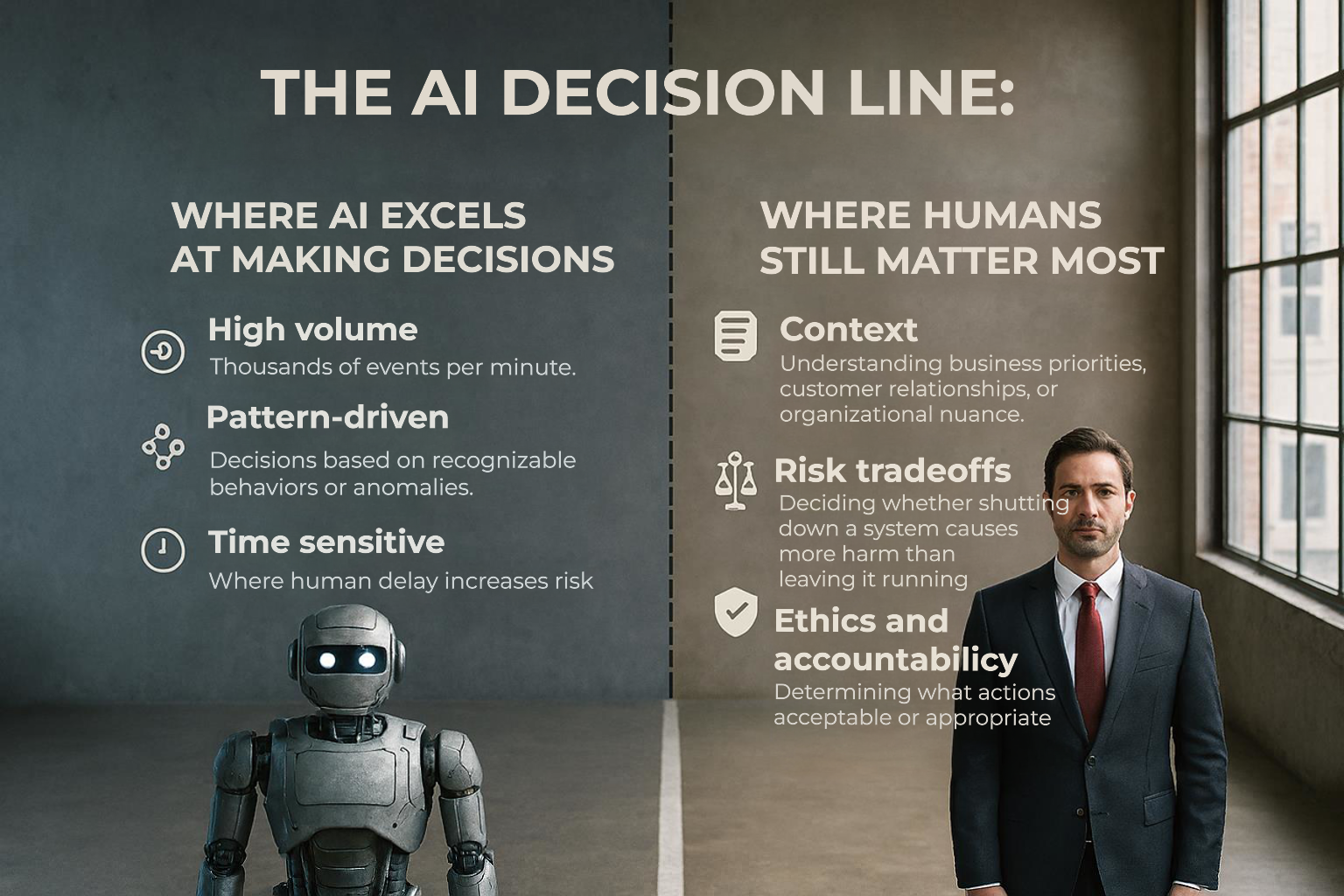
The real opportunity lies in defining what can be called the AI Decision Line, the boundary between automated action and human judgment.
Where AI Excels at Making Decisions
AI performs best in environments where decisions share several characteristics.
High Volume
AI can evaluate thousands of events per minute without fatigue. Tasks that overwhelm human analysts can be processed instantly.
Pattern Driven
Machine learning systems are particularly strong at recognizing patterns, anomalies, and correlations across large data sets.
Time Sensitive
In many scenarios, speed matters. Delays increase operational risk.
Cybersecurity environments illustrate this well.
Modern security platforms already rely on AI to:
- Detect abnormal login behavior
- Identify compromised endpoints
- Prioritize vulnerabilities across large environments
- Automatically isolate infected devices
In these situations, AI is not replacing human expertise. It is performing tasks that humans cannot realistically perform fast enough.
Where Human Judgment Remains Critical
Despite AI’s strengths, there are still decision types where human oversight is essential.
AI struggles when decisions require deeper context, nuanced judgment, or ethical evaluation.
Context Awareness
Humans understand organizational priorities, relationships, and situational nuance in ways current AI systems cannot fully replicate.
Risk Tradeoffs
Some decisions require balancing competing risks. For example, shutting down a system might prevent a security incident but disrupt critical operations.
Ethics and Accountability
Organizations remain accountable for the actions their systems take. Ethical considerations and reputational risks often require human judgment.
Consider a common scenario.
AI may detect suspicious behavior and recommend isolating a device. However, determining whether that device belongs to an executive during a critical meeting may require human confirmation.
That type of contextual judgment remains difficult for automated systems.
How Successful Organizations Draw the AI Decision Line
The organizations seeing the greatest success with AI automation follow a clear principle.
AI executes, humans govern.
This means dividing responsibilities intentionally.
AI systems handle tasks such as:
- Detection of anomalies and threats
- Prioritization of alerts or vulnerabilities
- Repetitive remediation tasks
- Large scale data analysis
Humans remain responsible for:
- Policy creation and governance
- Escalation and exception decisions
- Strategic risk evaluation
- Oversight of automated systems
When these roles are clearly defined, automation becomes a multiplier rather than a source of uncontrolled risk.
Practical Ways to Define the AI Decision Boundary
Organizations implementing AI driven automation should establish clear decision boundaries early.
Define Automated Decision Categories
Document which decisions AI can execute without human intervention, which require review, and which must remain human controlled.
Implement Escalation Paths
Create structured escalation workflows when AI systems encounter ambiguous situations or high impact actions.
Build Guardrails Before Automation
Automation should only execute within predefined policies and controls. This includes limits on the types of systems affected and the scale of automated actions.
Regularly Review Automated Decisions
Periodic audits of AI driven actions help identify drift, errors, or unintended outcomes before they become systemic problems.
The Leadership Challenge Behind AI Automation
The greatest risk organizations face today is not adopting AI too quickly.
It is deploying automation without clearly defining the boundaries of decision making.
Every organization implementing AI should ask three critical questions:
- What decisions can AI execute automatically?
- What actions require human approval?
- What safeguards must exist before automation runs?
When those questions are answered clearly, AI becomes a powerful accelerator.
When they are ignored, automation can introduce significant operational and security risk.
AI Should Elevate Human Decision Making
AI is not about replacing human decision makers.
It is about elevating them.
By allowing AI systems to handle repetitive analysis and operational noise, organizations free people to focus on higher value decisions.
The future will belong to organizations that allow AI to manage the noise while human leaders concentrate on the decisions that truly matter.
FAQs: AI Automation and Decision Governance
1. What is the AI decision line?
The AI decision line is the boundary between actions that automation can perform independently and decisions that require human oversight or approval.
2. Why is defining automation boundaries important for security teams?
Without clear boundaries, automated systems may execute actions that disrupt operations or create unintended risk. Defined guardrails ensure AI accelerates response without losing control.
3. Which cybersecurity actions are safest to automate first?
Detection, alert prioritization, and initial containment actions are typically good candidates for automation because they are high volume, pattern driven, and time sensitive.
Want to be the first to know when new blogs are published? Sign up for our newsletter and get the latest posts delivered straight to your inbox. From actionable insights to cutting-edge innovations, you'll gain the knowledge you need to drive your business forward.