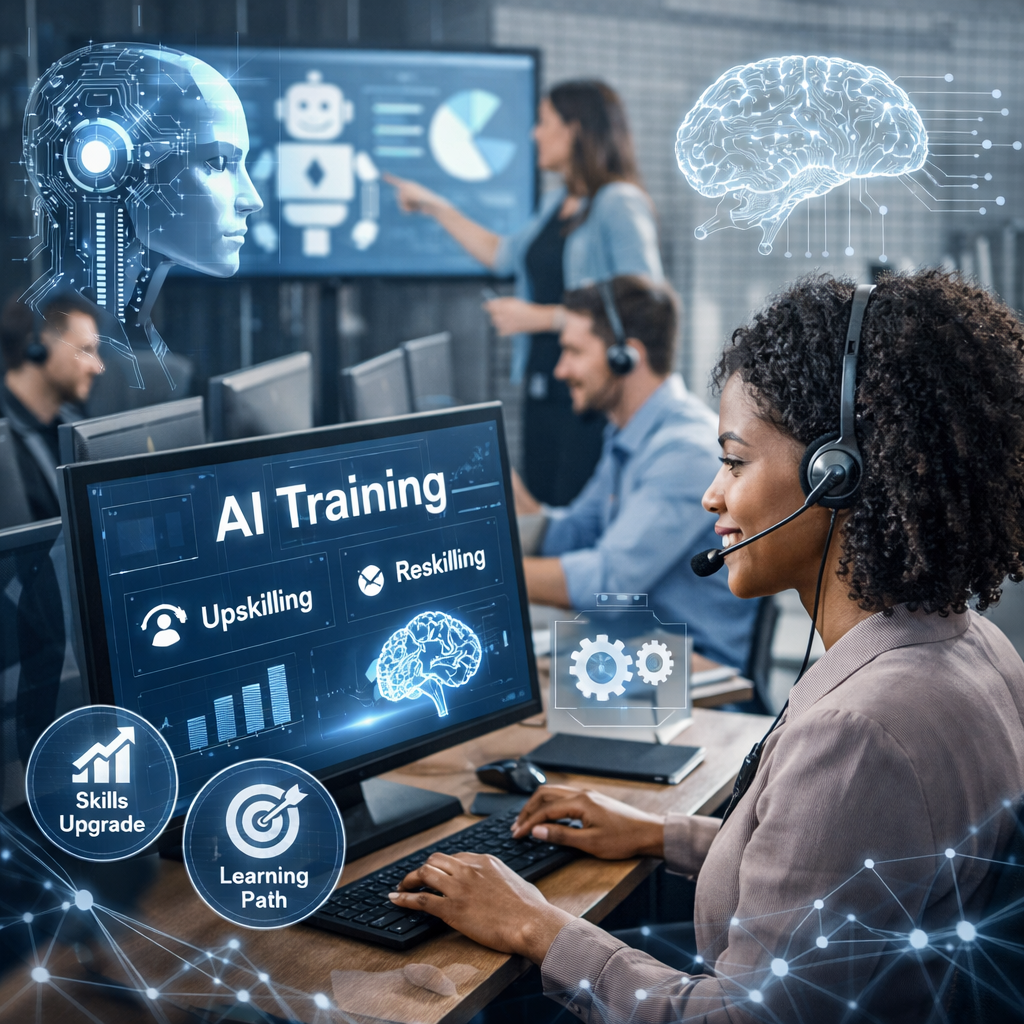
The integration of Artificial Intelligence in contact centers is not a future possibility, it is today’s reality. The workplace has shifted from a human versus machine mindset to a human with machine model. AI is not replacing the workforce, it is reshaping it.
For contact centers, this transformation creates both urgency and opportunity. The key to success lies in proactive reskilling and upskilling strategies that empower teams to thrive in AI-enhanced environments.
Why Reskilling Is Essential in AI-Driven Contact Centers
AI and automation are increasingly handling repetitive tasks such as basic inquiries, call routing, ticket categorization, and data entry. This evolution does not eliminate jobs, it transforms them.
Reskilling prepares employees for emerging roles that emphasize:
- Complex problem solving
- Customer empathy and relationship management
- Data interpretation and decision support
- AI tool oversight and optimization
In short, reskilling shifts focus toward uniquely human strengths that technology cannot replicate.
Practical Ways Contact Centers Can Implement Reskilling
- Identify tasks most impacted by automation and map them to future-ready roles
- Transition agents into roles such as AI supervisors, quality analysts, or customer journey specialists
- Offer certifications in AI-supported platforms used within the contact center
Reskilling ensures that workforce transformation strengthens rather than disrupts operations.
The Strategic Value of Upskilling
While reskilling prepares employees for new roles, upskilling enhances performance within existing ones.
In AI-enabled contact centers, upskilling focuses on:
- Leveraging AI-powered agent assist tools
- Interpreting sentiment analysis and predictive insights
- Managing more complex, high-value customer interactions
Upskilling strengthens human and AI collaboration rather than creating competition between them.
Practical Ways Contact Centers Can Implement Upskilling
- Train agents on interpreting AI recommendations and next-best-action prompts
- Provide workshops on data-driven decision making
- Develop advanced soft skill programs focused on empathy and conflict resolution
When agents understand how to use AI tools effectively, productivity and service quality both improve.
Aligning AI Transformation with Employee Career Goals
Technology transformation succeeds when employees feel included in the journey.
Open dialogue about career aspirations allows leaders to align AI initiatives with professional growth opportunities. When employees see how AI enhances their future prospects, adoption resistance decreases significantly.
Practical Ways Contact Centers Can Implement This
- Conduct quarterly career development conversations
- Create transparent career progression maps tied to new skill acquisition
- Offer mentorship programs focused on AI-driven career paths
Personalized development increases engagement and retention.
Building an Effective Reskilling and Upskilling Strategy
1. Forecast Future Skill Requirements
AI adoption changes required competencies. Leaders must anticipate which skills will grow in demand.
Implementation examples:
- Analyze upcoming AI initiatives to identify needed competencies
- Benchmark against industry trends in AI-enabled contact centers
- Conduct skills gap assessments across teams
2. Design Tailored AI Training Programs
Generic training programs are ineffective. AI education must reflect the specific tools and workflows used in your contact center.
Training should include:
- AI-powered customer service tools
- Data analytics for customer insights
- Ethical AI usage and compliance awareness
- Enhanced soft skills such as empathy and strategic communication
Implementation examples:
- Provide hands-on training using live AI systems
- Create sandbox environments for practice
- Combine e-learning with real-world application exercises
3. Develop Personalized Learning Pathways
Every employee has different strengths, goals, and learning preferences.
Implementation examples:
- Offer modular training tracks based on career aspirations
- Use AI-driven learning platforms to recommend personalized content
- Allow employees to choose specializations such as analytics, automation, or customer strategy
4. Provide Clear Career Advancement Pathways
Employees are more motivated to engage in learning when advancement is visible.
Implementation examples:
- Publish internal AI career tracks
- Tie skill certifications to promotion criteria
- Recognize and reward skill acquisition
5. Use AI to Enhance Learning
AI itself can improve training delivery by identifying skill gaps and recommending targeted development.
Implementation examples:
- Use AI analytics to assess performance trends
- Deliver adaptive learning modules
- Provide real-time coaching suggestions based on live interactions
6. Foster a Culture of Continuous Learning
Reskilling is not a one-time event. It must be embedded into the organization’s culture.
Implementation examples:
- Allocate dedicated learning hours monthly
- Provide access to online learning platforms
- Encourage peer-to-peer knowledge sharing
7. Promote Collaborative Learning
AI-enhanced workplaces require collaboration between teams and technologies.
Implementation examples:
- Host workshops focused on human and AI collaboration
- Create cross-functional innovation teams
- Encourage shared problem solving sessions
8. Monitor and Continuously Improve Programs
Training must evolve as AI evolves.
Implementation examples:
- Collect employee feedback regularly
- Measure training effectiveness through performance metrics
- Adjust programs to reflect technology upgrades
9. Partner with Educational Institutions
External partnerships expand access to advanced learning resources.
Implementation examples:
- Collaborate with universities offering AI certifications
- Provide access to accredited online programs
- Sponsor continuing education initiatives
The Critical Role of Leadership in AI Workforce Transformation
Leadership sets the tone for learning culture and technology adoption.
Leaders must:
- Demonstrate commitment to continuous learning
- Align training programs with strategic business goals
- Communicate clear benefits of skill development
- Reinforce the connection between AI proficiency and career advancement
When leadership models adaptability, teams follow.
Conclusion: Shaping the Future of Human and AI Collaboration
AI integration in contact centers is not about replacement, it is about elevation. Reskilling and upskilling empower employees to work alongside AI, leveraging technology to enhance performance rather than diminish it.
Organizations that invest in workforce development today will lead tomorrow’s customer experience landscape.
By fostering continuous learning, aligning development with career aspirations, and equipping teams with AI fluency, contact centers can create an environment where both people and technology thrive.
Ready to Prepare Your Contact Center for AI Transformation?
At CloudNow Consulting, we help contact centers design AI strategies that include both technology implementation and workforce readiness planning. From platform selection to structured training programs, we guide you every step of the way.
Schedule a free consultation today to discover how AI can empower your team and strengthen your operations.
FAQs: Reskilling and Upskilling in AI-Enabled Contact Centers
1. Will AI eliminate contact center jobs?
AI typically automates repetitive tasks, allowing agents to focus on higher-value interactions. Most roles evolve rather than disappear.
2. What skills are most important for AI-enabled contact center agents?
Critical thinking, empathy, data interpretation, AI tool proficiency, and complex problem solving are increasingly valuable.
3. How long does it take to see results from reskilling programs?
Many contact centers see measurable performance improvements within a few months when training is aligned with active AI initiatives.
Want to be the first to know when new blogs are published? Sign up for our newsletter and get the latest posts delivered straight to your inbox. From actionable insights to cutting-edge innovations, you'll gain the knowledge you need to drive your business forward.