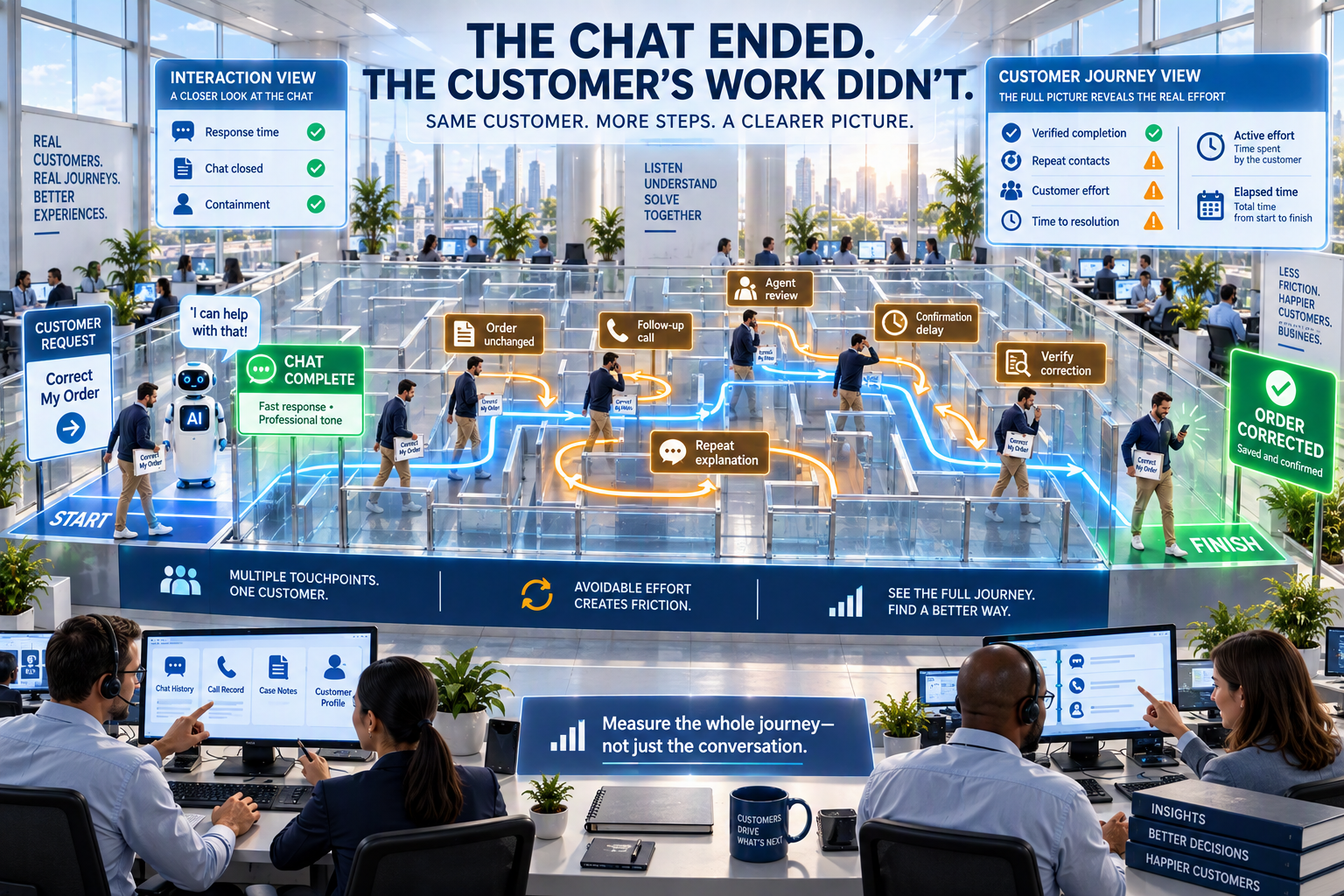
Your AI assistant handles a customer request in just a few minutes.
The conversation is friendly, the responses are quick, and the customer leaves believing their issue has been resolved.
From the AI dashboard, everything looks successful.
But the next day, the customer calls your contact center because the requested change never happened.
Now they have to explain the issue again, wait for an employee to review the previous conversation, and spend additional time getting the request completed.
Was the original AI interaction really successful?
Not from the customer's perspective.
This is one of the challenges contact centers face when measuring AI-powered customer service.
A quick interaction does not necessarily mean an easy customer experience.
Customers care about getting their issues resolved correctly, with as little unnecessary effort as possible.
That means contact centers need to look beyond individual AI conversations and understand the complete customer journey.
Here are six ways to measure customer effort more effectively and identify opportunities to improve the experience.
1. Define What a Completed Customer Request Looks Like
Before measuring customer effort, contact centers need to establish what a successful outcome means.
This should begin with a specific customer request rather than a broad measurement of all AI interactions.
For example, consider a customer who wants to change an appointment.
The request should not be considered complete simply because the AI told the customer the appointment was updated.
A successful outcome may require:
- Confirming the customer's identity
- Locating the correct appointment
- Saving the new appointment time
- Releasing the original appointment
- Sending an accurate confirmation
- Verifying that the changes were recorded correctly
These steps help define the complete customer journey.
Contact centers should also identify where the customer begins, which systems are involved, and whether the request continues after the initial interaction.
A customer might start in chat, move to a phone call, and eventually receive confirmation by email.
If each channel reports its results independently, the organization may miss the total effort required to complete the request.
Practical Ways Contact Centers Can Implement This
- Start with one high-volume customer request. Choose a common workflow such as an appointment change, order correction, or billing inquiry.
- Define measurable completion criteria. Document what must happen in the system before the request can be considered successfully resolved.
- Map the entire customer journey. Identify where customers begin, which channels they use, and how completion is verified.
Unresolved requests should remain visible in reporting.
A conversation ending without a transfer does not automatically mean the customer's issue was resolved.
2. Combine Customer Effort Score With Operational Metrics
Customer Effort Score, commonly called CES, is a useful way to understand how easy or difficult customers find an experience.
However, CES should not be the only measure of customer effort.
A customer may rate an AI conversation positively because it was quick and convenient, even if the requested action was never completed.
That is why contact centers should combine customer feedback with operational data.
Important Customer Effort Metrics to Track
Customer Effort Score (CES)
Measures how easy or difficult customers felt it was to complete a request.
Verified Resolution Rate
Measures whether the customer's intended outcome was completed correctly.
Repeat Contact Rate
Tracks how often customers contact the organization again about the same issue within a defined period.
Transfer and Channel Change Rate
Shows how frequently customers move between AI, human agents, and other service channels.
Repeated Information Rate
Identifies how often customers must provide details they have already shared.
Time to Resolution
Measures how long it takes to complete the request, including activity that happens after the initial conversation.
Contact centers should distinguish between elapsed time and active customer effort where possible.
Waiting two days for an issue to be resolved is different from spending twenty minutes repeating information to multiple employees.
Both matter, but they point to different improvement opportunities.
Practical Ways Contact Centers Can Implement This
- Build a customer effort scorecard. Combine CES with verified resolution, repeat contacts, transfers, and time to resolution.
- Establish appropriate follow-up periods. Use different windows for routine account changes and more complex service requests.
- Connect interaction data across channels. Where systems allow, use approved customer or case identifiers to follow the same request across AI and human interactions.
The objective is to understand the effort required to achieve the outcome, not simply the effort within one conversation.
3. Ask Customer Effort Survey Questions That Reflect the Full Experience
Surveys can provide valuable insight into customer effort, but the timing and wording of the questions matter.
For example, a survey delivered immediately after an AI chat may ask whether the interaction was easy.
The customer may say yes.
But if they later discover that the requested change was not completed, their experience becomes much more difficult.
The original survey captured only part of the journey.
Contact centers should decide whether they want feedback about a specific interaction or the overall request.
Those are different things.
A more useful question for an appointment change might be:
"How easy was it to complete your appointment change?"
This focuses on the customer's intended outcome rather than the channel they used.
Surveys should also be short and consistent so results can be compared over time.
Practical Ways Contact Centers Can Implement This
- Use outcome-focused survey questions. Ask about the ease of completing the customer's actual request.
- Offer an optional comment field. Give customers an opportunity to explain what made the experience difficult.
- Review survey participation. Check whether customers who abandon the AI experience or require additional assistance are represented.
- Verify completion separately. Do not rely on a positive survey response as proof that a transaction succeeded.
A small change in CES should prompt investigation rather than an automatic conclusion that performance improved or declined.
The feedback becomes more meaningful when combined with what actually happened.
4. Identify Where Customers Have to Repeat Work
One of the clearest signs of unnecessary customer effort is repetition.
Customers should not have to repeatedly explain the same issue, provide the same information, or restart a process because systems and teams are not connected.
Yet these problems can occur when AI agents transfer customers, transactions fail, or previous interactions are not available to employees.
Common examples include:
- Repeating the reason for contacting the company
- Providing information already collected by AI
- Rephrasing the same question multiple times
- Retrying an action without knowing whether it succeeded
- Switching channels because the next step is unclear
- Contacting customer service again to confirm progress
These experiences create frustration even when individual interactions appear efficient.
However, not every repeated step is unnecessary.
Certain security or verification requirements may need to be completed again depending on the situation.
Contact centers should work with the appropriate process and security owners before removing required checks.
Practical Ways Contact Centers Can Implement This
- Review conversation transcripts and recordings. Look for repeated questions, customer corrections, and unnecessary clarification.
- Collect frontline employee feedback. Ask agents to identify situations where customers regularly have to start over.
- Improve AI to human handoffs. Make relevant conversation context available to receiving employees through approved systems.
- Separate required steps from avoidable repetition. Preserve necessary verification and compliance procedures while reducing unnecessary effort.
The goal is not to eliminate every step.
It is to eliminate work that does not help the customer reach the right outcome.
5. Compare Similar Customer Requests Before Evaluating AI Performance
Not every customer interaction requires the same amount of effort.
A simple order status inquiry is different from a complicated billing dispute.
An AI agent may complete one request in seconds while another requires additional questions, verification, or human approval.
Comparing those interactions without considering their complexity can create misleading conclusions.
For example, an AI-only conversation may appear more efficient because it is shorter.
But if the customer later contacts a human agent to complete the same request, the total effort may be higher.
Meanwhile, a longer interaction that resolves the issue correctly the first time may provide a better customer experience.
Contact centers should compare similar requests and examine the complete path to resolution.
Practical Ways Contact Centers Can Implement This
- Segment reporting by customer intent. Compare appointment changes with appointment changes, billing inquiries with billing inquiries, and other similar requests.
- Review different resolution paths. Compare AI-only, AI-to-human, and human-assisted journeys for similar types of work.
- Investigate unusually difficult experiences. Look beyond averages to identify workflows with repeated failures, long delays, or multiple transfers.
- Document reporting limitations. If customer interactions cannot be reliably linked across channels, make that limitation clear.
A lower average handle time does not automatically mean customers are experiencing less effort.
The better question is whether customers can complete comparable requests with fewer unnecessary steps.
6. Use Customer Effort Findings to Improve Specific Workflows
Measuring customer effort is only valuable when the results lead to meaningful improvements.
A dashboard showing that customers are struggling is a starting point.
The next step is understanding why.
Suppose a contact center discovers that customers frequently call after using AI to change an appointment.
Rather than immediately rewriting the AI's instructions, the team should review a sample of those journeys.
Did the scheduling system fail to save the change?
Did the AI provide incorrect confirmation?
Was the appointment updated correctly, but the customer never received a notification?
Did the customer misunderstand when the change would take effect?
Each situation requires a different solution.
The team should identify the actual cause, assign an owner, and make a targeted correction.
Practical Ways Contact Centers Can Implement This
- Trace repeat-contact journeys. Review the original AI interaction, follow-up contacts, and final system outcome.
- Assign improvements to the appropriate team. Involve operations, IT, knowledge management, or AI administrators based on the cause.
- Test the corrected workflow. Verify that the issue is resolved without introducing new problems.
- Measure the results after release. Check whether repeat contacts, customer effort, and unresolved requests decrease.
For example, if appointment changes were completed correctly but customers received unclear confirmations, improving the confirmation message may reduce unnecessary follow-up calls.
However, the team should verify that the change worked rather than assuming the problem is resolved.
Reducing customer effort should never come at the expense of accuracy, security, or successful task completion.
How to Build a Customer Effort Measurement Process for AI
Contact centers do not need to measure every possible customer journey at once.
A more practical approach is to begin with one important workflow and establish a repeatable process.
Start by defining what a successful outcome looks like.
Then identify the information needed to follow the request from the first customer interaction through completion.
Review customer feedback alongside operational measures such as repeat contacts, transfers, and verified resolution.
Look for patterns that indicate unnecessary effort.
Finally, use those findings to make a specific improvement and confirm whether it helped.
Practical Ways Contact Centers Can Implement This
- Create a workflow-level customer effort dashboard. Bring together CES, completion rates, repeat contacts, transfers, and resolution time.
- Review a sample of complete customer journeys. Include both successful requests and those requiring additional assistance.
- Set regular improvement reviews. Use findings to prioritize changes, assign owners, and evaluate results.
This approach helps contact centers understand what customers experience across the entire service process rather than relying on isolated interaction metrics.
Customer Effort Does Not End When the AI Conversation Ends
AI agents can make customer service faster and more convenient.
But the experience is only easier when customers can accomplish what they came to do.
A short conversation that leads to another call is not necessarily an improvement.
A friendly response that confirms an action that never happened creates more work for everyone.
And a successful transfer means little if the customer has to explain the entire issue again.
That is why measuring customer effort requires a broader view.
Contact centers need to follow the request from the customer's first attempt through the final outcome.
They need to understand where customers repeat information, wait without clarity, or contact the company again because the original request remains unresolved.
Start with one common customer journey.
Define success.
Measure the effort required to get there.
Then use the findings to remove unnecessary friction while protecting accuracy and required controls.
The real goal is not simply to make AI interactions easier. It is to make the entire customer service experience easier.
Ready to Reduce Customer Effort in Your Contact Center?
At CloudNow Consulting, we help organizations evaluate, implement, and optimize AI and contact center solutions that support better customer experiences and more efficient operations.
Whether you are measuring Customer Effort Score, reviewing repeat contacts, improving AI to human handoffs, or identifying friction across customer journeys, our team can help you evaluate the right technology and operational improvements.
Reach out to CloudNow Consulting today to discuss how your contact center can reduce unnecessary customer effort while improving resolution and service quality.
FAQs: Customer Effort in AI-Powered Contact Centers
1. What is Customer Effort Score, and why is it important for AI-powered contact centers?
Customer Effort Score (CES) measures how easy or difficult customers perceive an experience to be. For AI-powered contact centers, it helps identify whether automated service is convenient and straightforward. However, CES should be reviewed alongside verified resolution, repeat contacts, and other operational metrics to understand the full customer journey.
2. How can contact centers measure customer effort across AI and human interactions?
Contact centers can use approved customer or case identifiers to connect related interactions across channels. By combining survey feedback, repeat contact data, transfer history, time to resolution, and verified task completion, organizations can better understand how much effort customers expend before their requests are resolved.
3. How can AI help reduce customer effort in contact centers?
AI can reduce customer effort by answering routine questions, completing supported transactions, collecting relevant information, and transferring customers to human agents with useful context. To achieve these benefits, contact centers should monitor accuracy, successful completion, repeat contacts, and handoff quality, then correct workflows that create unnecessary repetition or delays.
Want to be the first to know when new blogs are published? Sign up for our newsletter and get the latest posts delivered straight to your inbox. From actionable insights to cutting-edge innovations, you'll gain the knowledge you need to drive your business forward.