Your AI agent sounds professional.
It responds quickly, follows a consistent tone, and handles customer conversations without much difficulty.
The quality dashboard shows strong results.
But then a frontline employee notices something.
Customers asking about a particular policy are receiving incomplete answers. The AI sounds confident, but it is leaving out an important exception.
Would your current quality assurance process catch that problem?
And if it did, would your team know who was responsible for fixing it?
These are important questions for contact centers using AI-powered customer service.
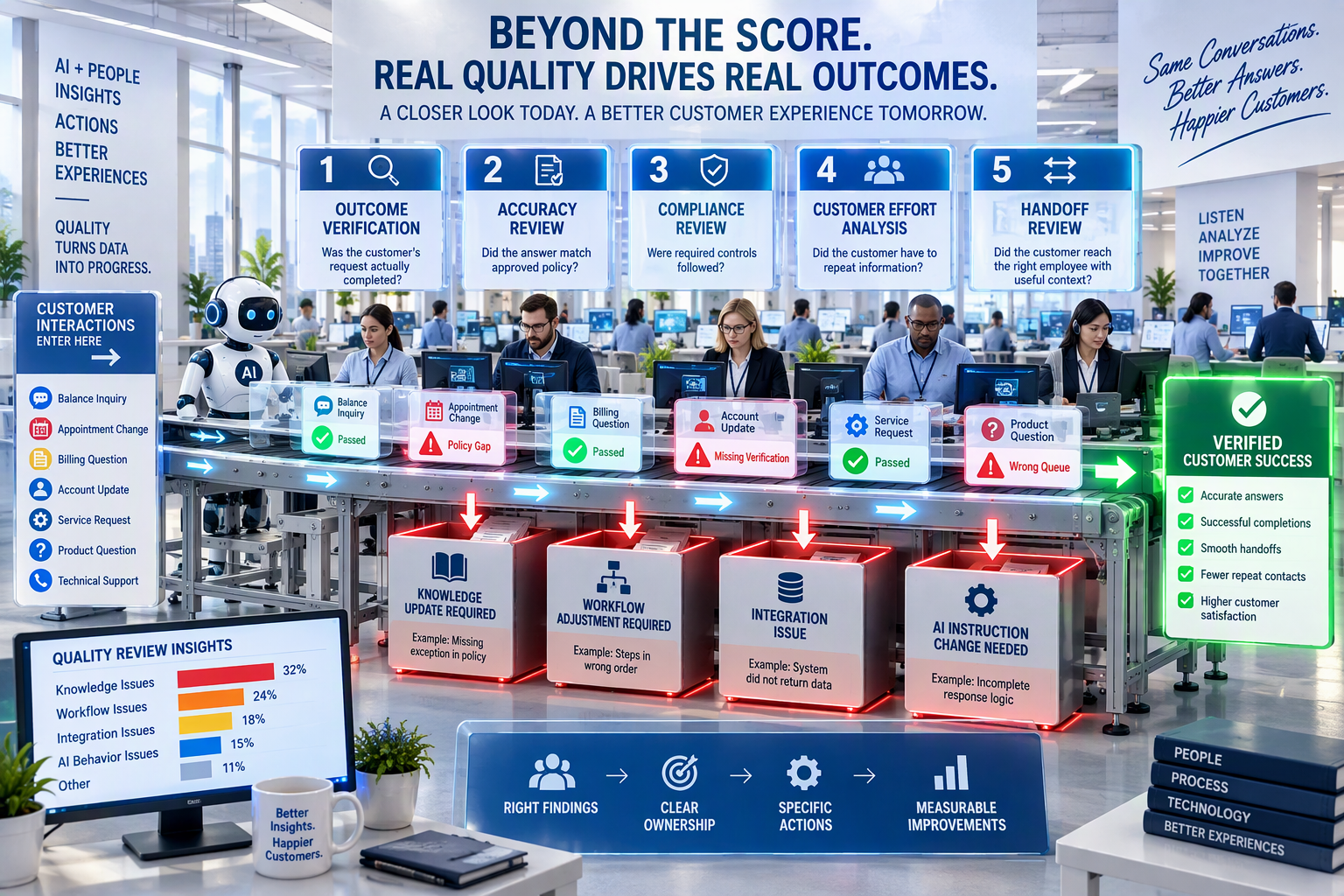
Traditional quality assurance often focuses on how employees communicate, follow procedures, and resolve customer issues. AI quality assurance needs to examine many of those same areas, but it also needs to verify whether automated interactions are producing accurate, appropriate, and complete outcomes.
A high AI quality score does not automatically mean customers are receiving the right answers.
The goal of AI quality assurance should be to identify what is working, uncover what needs improvement, and give the right teams enough information to take action.
Here are six ways contact centers can build a more effective AI quality assurance process.
1. Define What a Successful AI Customer Interaction Looks Like
Before scoring AI conversations, contact centers need to agree on what success means.
And that definition should depend on what the customer is trying to accomplish.
For example, a customer checking an account balance may need accurate information after completing the required verification.
A customer requesting a service change may need the AI to complete the transaction, confirm the result, and explain when the change will take effect.
These interactions require different outcomes.
That means a single generic quality scorecard may not provide enough detail to evaluate both effectively.
Contact centers should define success criteria for each major AI workflow, including:
- The customer's intended outcome
- Required verification or authorization
- Information the AI must provide
- Actions the AI must complete
- Required confirmations or disclosures
- Conditions that require human escalation
These expectations should be established before the interactions are evaluated.
Otherwise, reviewers may give too much weight to a friendly tone, quick response, or short conversation while overlooking whether the customer actually received the help they needed.
Practical Ways Contact Centers Can Implement This
- Create workflow-specific success criteria. Document what must happen for common requests such as billing inquiries, appointment changes, and account updates.
- Involve frontline employees and process owners. Ask experienced agents to identify important details and exceptions that may not appear in a general scorecard.
- Separate conversation quality from business outcomes. Evaluate whether the AI communicated effectively and whether the request was actually resolved.
A successful AI interaction should be measured by what the customer accomplished, not simply how smoothly the conversation sounded.
2. Review Both Routine AI Conversations and Problem Interactions
When evaluating AI performance, it is natural to focus on complaints, failed transfers, and interactions that generated customer frustration.
Those conversations are valuable because they reveal where something went wrong.
But they do not provide a complete picture of AI performance.
If contact centers only review reported problems, they may miss issues occurring in conversations that customers never complain about.
For example, an AI agent may provide an incomplete answer that sounds reasonable enough for the customer to accept.
The interaction ends without a complaint or escalation.
Unless that conversation is included in a routine quality review, the problem may go unnoticed.
That is why an effective AI quality assurance program should include two types of reviews.
Routine Quality Reviews
These involve a sample of interactions selected across the workflows, channels, languages, and customer request types supported by the AI.
The purpose is to understand how the AI performs during normal operations.
Targeted Quality Reviews
These focus on interactions with known or suspected problems, such as:
- Customer complaints
- Repeat contacts
- Failed transactions
- Unsuccessful transfers
- Employee-reported issues
- High-risk customer requests
- Potential policy or compliance failures
Both types of reviews are important, but their results should remain distinguishable.
A targeted sample selected because something went wrong should not be presented as the overall AI failure rate.
Practical Ways Contact Centers Can Implement This
- Establish a regular sampling process. Review interactions across different customer intents, channels, and workflows.
- Create a separate review queue for problem cases. Prioritize complaints, failed actions, repeat contacts, and employee flags.
- Adjust sampling based on risk and volume. Give additional attention to sensitive workflows and ensure lower-volume interactions are not overlooked.
Reviewing more conversations can provide additional insight, but the quality and purpose of the sample matter just as much as the quantity.
3. Build an AI Quality Scorecard That Measures What Matters
A useful AI quality scorecard should help reviewers make consistent decisions.
Broad questions such as "Did the AI provide a good customer experience?" can lead to different interpretations.
One reviewer may focus on tone.
Another may focus on accuracy.
A third may focus on whether the issue was resolved.
Without clear definitions, the resulting scores become difficult to compare.
Instead, contact centers should use specific evaluation criteria supported by evidence.
Customer Understanding
Did the AI correctly identify what the customer wanted?
Did it recognize corrections or changes in the request?
Response Accuracy
Was the information correct, complete, and consistent with approved company policies?
Did it apply to the customer's actual situation?
Task Completion
Did the AI successfully complete the requested action?
If the task could not be completed, did it explain the limitation accurately?
Security and Compliance
Did the AI follow required verification, disclosure, authorization, and data-handling procedures?
Customer Effort
Did the customer have to repeat information, rephrase questions, or complete unnecessary steps?
Human Escalation
When human assistance was required, did the AI transfer the customer appropriately and provide useful context?
For each criterion, reviewers should understand what constitutes a passing result, a failure, or a situation where the criterion does not apply.
There should also be a way to identify cases where the available evidence is insufficient to verify the outcome.
For example, if the AI says an address was updated but the reviewer cannot access the CRM record, the result should not automatically be marked successful.
Practical Ways Contact Centers Can Implement This
- Use clearly defined scoring criteria. Provide examples of successful and unsuccessful interactions for each category.
- Require supporting evidence. Allow reviewers to reference conversation transcripts, recordings, and system records.
- Include an "unable to verify" option. Keep incomplete evidence visible rather than treating uncertain outcomes as successful or unsuccessful by default.
A shorter scorecard with clear definitions can be more useful than a complicated one that produces inconsistent results.
4. Separate Critical AI Errors From General Quality Scores
Not all AI mistakes carry the same level of risk.
An AI agent missing a preferred closing statement is very different from one providing information to an unauthorized person.
Both may affect quality, but they should not be handled the same way.
This is why contact centers need to identify critical errors separately from general quality scoring.
Examples may include:
- Unauthorized account changes
- Disclosure of sensitive customer information
- Failure to follow required authentication procedures
- Missing mandatory disclosures
- Actions outside the AI's approved authority
- Incorrect information in high-risk transactions
A strong overall quality score should never hide a serious issue in one of these areas.
For example, an AI interaction might perform well across most evaluation categories but still fail to verify the customer's identity before making an account change.
That failure deserves immediate attention, regardless of the total score.
Contact centers should also distinguish between confirmed critical failures and cases where reviewers lack enough information to determine what happened.
Both may require investigation, but they represent different findings.
Practical Ways Contact Centers Can Implement This
- Define critical error categories. Work with operations, security, and compliance teams to identify unacceptable failures.
- Create immediate escalation procedures. Establish who investigates critical findings and when an affected AI workflow should be paused.
- Report critical errors separately. Make serious incidents visible alongside overall quality scores rather than allowing them to disappear inside an average.
The purpose is not to penalize AI for every minor imperfection.
It is to recognize when an issue creates meaningful risk for customers or the business.
5. Calibrate AI Quality Reviews for Consistent Scoring
Even a well-designed scorecard can produce unreliable results if reviewers interpret the criteria differently.
This is where quality assurance calibration becomes important.
Calibration involves having multiple reviewers evaluate the same interactions independently and then compare their findings.
The goal is to understand where scoring differences occur and why.
For example, one reviewer may mark an answer as accurate because it matches the standard company policy.
Another reviewer may mark it as inaccurate because the customer's situation required an exception.
That disagreement may reveal a problem with the scorecard, the underlying policy, or the information available to reviewers.
Calibration helps identify these gaps before they affect broader reporting.
It becomes especially important when AI tools are used to evaluate AI conversations.
Automated quality scoring can help contact centers review more interactions, but those scores still need validation.
An AI evaluation tool may miss subtle policy exceptions, misunderstand customer context, or incorrectly classify an interaction as successful.
Practical Ways Contact Centers Can Implement This
- Hold regular calibration sessions. Have reviewers independently score the same interactions and discuss differences.
- Improve scoring definitions based on disagreements. Update evaluation guidance and examples when criteria are unclear.
- Validate automated quality scores. Compare AI-generated evaluations with knowledgeable human reviewers, including interactions the automated tool marked as successful.
Calibration should also be repeated when new workflows are introduced or evaluation criteria change.
Consistent scoring makes quality reporting more trustworthy and helps teams identify real performance trends.
6. Turn AI Quality Findings Into Specific Improvements
Finding a problem is only the beginning.
The real value of quality assurance comes from what the organization does with that information.
A general finding such as "AI accuracy needs improvement" does not provide enough direction.
A more useful finding might be:
"The AI explained the standard cancellation policy but failed to mention the exception that applies to customers with a particular service plan."
That statement identifies the problem clearly enough for someone to investigate it.
Contact centers should document:
- The affected customer workflow
- The specific failure
- Supporting interaction examples
- Potential customer impact
- The likely cause
- The responsible team
- The corrective action
- The results of follow-up testing
Different problems require different owners.
Knowledge management teams should address missing, outdated, or conflicting information.
Operations teams should investigate unclear workflows and process decisions.
IT teams should review system access, failed transactions, and integration problems.
AI administrators or platform providers should evaluate instructions, conversation behavior, and technical configuration.
Quality assurance teams should then verify that the correction actually worked.
Practical Ways Contact Centers Can Implement This
- Create an AI quality improvement tracker. Record recurring findings, assigned owners, corrective actions, and validation results.
- Retest affected workflows after changes. Review the original failed interactions and successful scenarios to identify unintended consequences.
- Monitor new interactions after deployment. Confirm that the issue is no longer occurring before closing the finding.
A quality issue should not be considered resolved simply because someone updated the knowledge article or changed the AI instructions.
The team needs evidence that the customer experience improved.
How to Make AI Quality Assurance an Ongoing Contact Center Process
AI quality assurance should not be treated as a one-time activity completed before deployment.
Customer expectations change.
Policies are updated.
New products are introduced.
Workflows evolve.
AI systems and their integrations also change over time.
A quality process needs to account for these changes without becoming unnecessarily complicated.
The most effective approach is to create a manageable review cycle that connects quality findings with operational improvements.
Practical Ways Contact Centers Can Implement This
- Start with one important workflow. Define the expected outcome, create evaluation criteria, and review a meaningful mix of interactions.
- Connect QA findings with operational reporting. Compare quality results with repeat contacts, escalation rates, customer satisfaction, and task completion.
- Assign ownership for recurring issues. Make sure every significant finding has someone responsible for investigating and resolving it.
- Review the effectiveness of corrections. Track whether changes improve the affected workflow over time.
The goal is not to create more dashboards or longer reports.
It is to give contact center leaders enough information to understand what customers are experiencing and decide what needs to change.
AI Quality Assurance Should Lead to Better Customer Outcomes
A quality score is useful when it helps your team make better decisions.
But a high score alone does not guarantee that an AI agent is delivering accurate answers or completing customer requests correctly.
The more important questions are:
Are customers receiving the right information?
Are their requests being completed?
Are serious errors being identified?
Do employees know what needs to be corrected?
And is someone confirming that those corrections actually work?
A strong AI quality assurance process connects those questions to specific evidence and clear ownership.
Start with one workflow.
Define success.
Review both routine and problematic interactions.
Calibrate the scoring.
Then use what you learn to make measurable improvements.
The best AI quality assurance programs do more than score conversations. They help contact centers deliver better customer experiences.
Ready to Strengthen AI Quality Assurance in Your Contact Center?
At CloudNow Consulting, we help organizations evaluate, implement, and optimize AI and contact center solutions based on their operational needs and customer experience goals.
Whether you are developing an AI quality assurance framework, reviewing automated scoring capabilities, or looking for ways to improve AI performance after deployment, our team can help you identify the right technology and processes for your business.
Reach out to CloudNow Consulting today to discuss how your contact center can build a more effective approach to AI quality assurance and continuous improvement.
FAQs: AI Quality Assurance in Contact Centers
1. What should an AI quality assurance scorecard include for a contact center?
An AI quality assurance scorecard should evaluate customer understanding, response accuracy, task completion, security and compliance requirements, customer effort, and human escalation. Each category should have clear scoring criteria and supporting evidence so reviewers can evaluate interactions consistently.
2. How often should contact centers review AI-generated customer interactions?
Contact centers should establish regular quality reviews based on interaction volume, workflow complexity, and customer risk. Routine samples should be reviewed alongside targeted interactions involving complaints, repeat contacts, failed transactions, and critical incidents. Higher-risk workflows may require more frequent monitoring.
3. Can AI automatically score the quality of other AI agents in a contact center?
Yes. Automated quality assurance tools can evaluate AI conversations against defined criteria and help contact centers review larger volumes of interactions. However, automated scoring should be validated against knowledgeable human reviewers, particularly for policy exceptions, sensitive transactions, and complex customer situations. Human oversight remains important for identifying errors that automated evaluations may miss.
Want to be the first to know when new blogs are published? Sign up for our newsletter and get the latest posts delivered straight to your inbox. From actionable insights to cutting-edge innovations, you'll gain the knowledge you need to drive your business forward.