
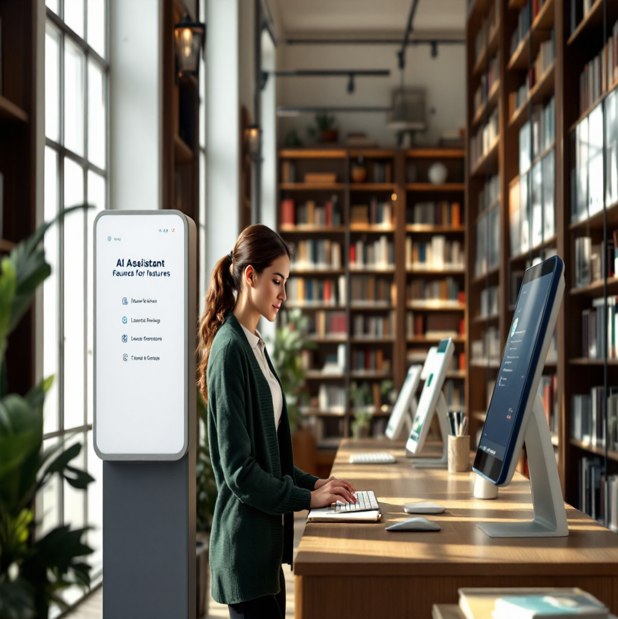
Imagine your cybersecurity infrastructure as a massive, high-value library. Endless rows of data “books,” each filled with critical insight. In the center, a security analyst, your overworked librarian, is doing their best to organize, respond, and protect every shelf, all while fending off digital intruders.
Now imagine that same librarian has an AI-powered assistant. Suddenly, the workload lightens, threats are flagged instantly, and everything just... works smarter.
That’s the power of AI in cybersecurity, not as a silver bullet, but as a strategic partner. Here’s how AI plays the role of the ultimate cybersecurity librarian’s assistant and why it’s quickly becoming indispensable for modern organizations.
1. Automating Tedious Security Tasks
The Shelving Wizard for Threat Alerts
Just like manually sorting books in a busy library, security teams are often stuck triaging mountains of alerts, logs, and event data. This manual work is not only time-consuming but introduces risk through human error or alert fatigue.
How AI Helps:
- Automates log analysis across SIEM, EDR, and firewall systems
- Flags anomalies in real time based on behavior baselines
- Reduces false positives by learning from historical patterns
Practical Implementation for Contact Centers:
AI tools can auto-triage alerts from customer interaction logs, voice analytics, and CRM activity. Suspicious login attempts or unauthorized data access can trigger immediate security playbooks via your SOAR platform.
Benefits:
- Faster incident detection
- Consistent prioritization of risks
- Reduced analyst burnout
2. Augmenting Security Teams
The Knowledgeable Assistant That Never Sleeps
Think of AI as the assistant who knows the entire library catalog, remembers every past breach, and can predict when and where the next issue might occur. Rather than replacing humans, AI enhances their decision-making by delivering real-time insights.
How AI Helps:
- Delivers predictive threat modeling based on historical data
- Recommends remediation actions based on playbooks or past outcomes
- Surfaces contextual information (e.g., device history, user behavior) during investigations
Practical Implementation for Contact Centers:
During a suspected account compromise, AI can surface the customer’s interaction history, flag inconsistencies, and suggest next best actions for agents, all in real time.
Benefits:
- Improved response accuracy
- Faster decision-making during investigations
- More confident analysts and reduced training time
3. Unified Threat Intelligence
The All-Seeing Eye of Your Cyber Library
The best librarians know what’s happening across the entire library, not just one shelf. In cybersecurity, AI serves as the all-seeing eye by unifying data sources, correlating threat intelligence, and identifying patterns across the entire digital ecosystem.
How AI Helps:
- Ingests and analyzes data from multiple systems (SIEM, SOAR, threat intel platforms)
- Correlates disparate indicators of compromise (IOCs)
- Presents a unified threat picture with prioritization scores
Practical Implementation for Contact Centers:
By integrating customer behavioral analytics with threat intel feeds, AI can help flag potential insider threats or fraud patterns early, before data loss or compliance issues occur.
Benefits:
- Full visibility across endpoints, networks, and applications
- Faster detection of multi-stage attacks
- Improved collaboration across teams using a single source of truth
The Bottom Line: Smarter Security Starts with AI
Like the perfect assistant in a complex library, AI in cybersecurity isn’t about replacing your team, it’s about amplifying their capability. With AI, you get:
- Fewer missed threats
- Less time spent on repetitive work
- More time focused on strategic security initiatives
And for contact centers, where customer trust is everything, AI plays a vital role in safeguarding sensitive information and ensuring regulatory compliance, without increasing operational complexity.
How CloudNow Consulting Can Help
At CloudNow Consulting, we specialize in helping businesses integrate AI into their cybersecurity ecosystem. From automation design to threat intelligence fusion and SOAR optimization, we’ll help you implement scalable, intelligent defense strategies.
👉 Contact us today to learn how to future-proof your security posture with AI and automation.
FAQs: AI in Cybersecurity
1. Is AI a replacement for cybersecurity analysts?
No. AI is designed to support and enhance human analysts by handling repetitive tasks, surfacing insights, and accelerating response times, not replace people.
2. What systems should I integrate with AI first?
Start with your SIEM and SOAR platforms. These are core to your detection and response workflows and benefit immediately from AI-driven automation and enrichment.
3. How can small to mid-sized contact centers use AI in cybersecurity?
Even smaller centers can adopt AI tools for use cases like phishing detection, suspicious login monitoring, and automated incident response using pre-built playbooks on cloud-native platforms.
Want to be the first to know when new blogs are published? Sign up for our newsletter and get the latest posts delivered straight to your inbox. From actionable insights to cutting-edge innovations, you'll gain the knowledge you need to drive your business forward.