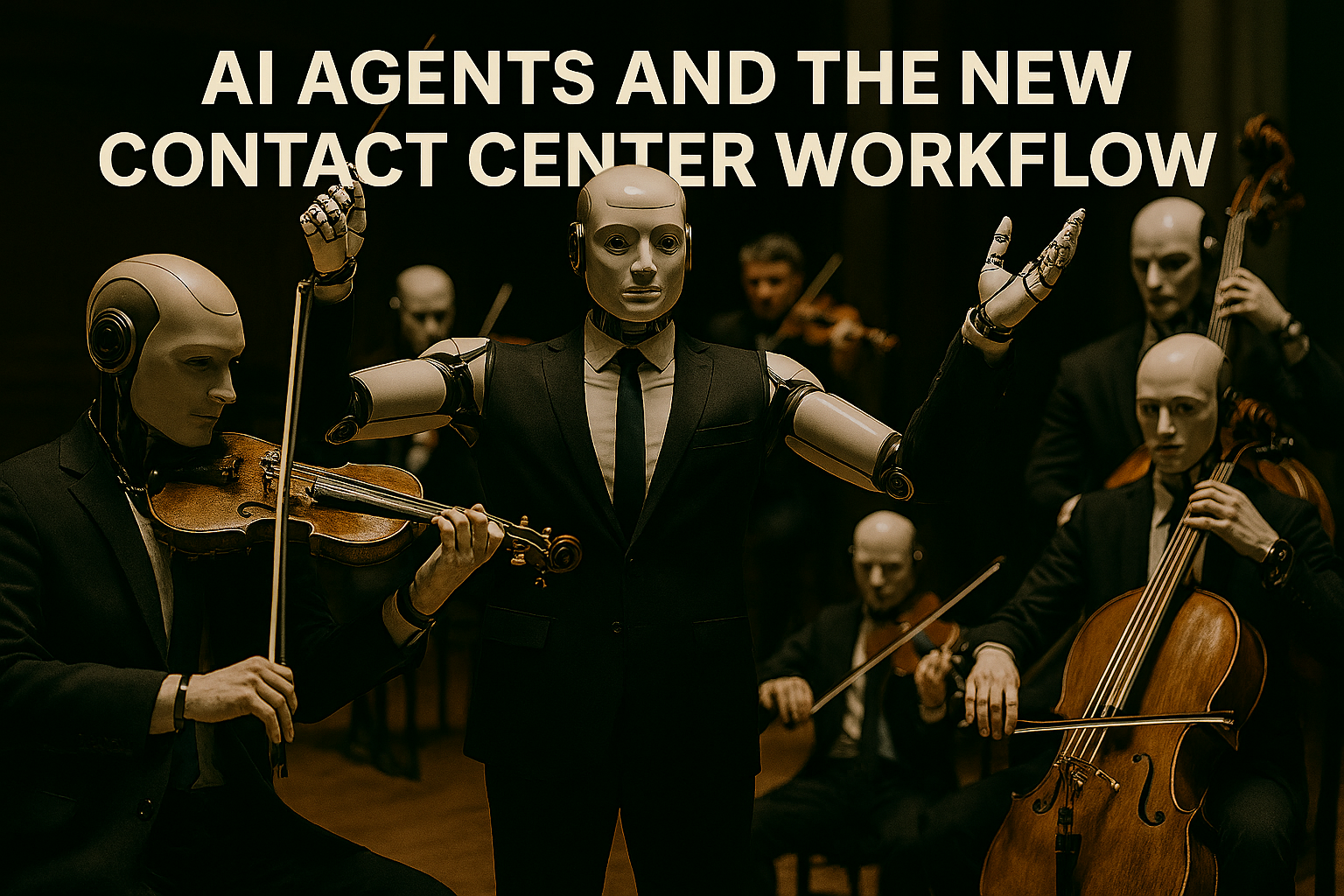
AI agents are no longer just supporting contact centers. They are becoming part of the workflow itself.
For years, contact centers have layered in technology to help agents move faster, handle more volume, and improve efficiency. But even with better systems, most of the work still depended on people stitching processes together, answering questions, searching for information, updating systems, documenting interactions, and coordinating next steps across teams.
That model is starting to shift.
AI agents are now embedded across the entire interaction lifecycle, not just at the front end.
From Isolated Tasks to Connected Workflows
Traditional contact center operations are often fragmented.
A single customer issue might involve:
- An agent handling the conversation
- Another team updating records
- A separate group reviewing quality
- Someone else managing follow-ups
This creates delays, duplicated effort, and inconsistent customer experiences.
AI agents help close these gaps by connecting the workflow end-to-end.
What AI Agents Can Now Do
AI can:
- Identify the reason for contact early
- Pull relevant account history automatically
- Recommend next-best actions
- Support agents in real time
- Summarize interactions instantly
- Trigger follow-up actions across systems
Instead of treating each interaction as a standalone event, AI enables a continuous, connected workflow.
How AI Changes the Role of the Human Agent
A common concern is whether AI replaces agents.
In reality, it reshapes their role.
Human agents are still essential for:
- Complex problem solving
- Emotional and sensitive conversations
- Exception handling
- Judgment-based decisions
AI removes friction around the interaction, not the interaction itself.
Practical Ways Contact Centers Can Implement This
- Deploy AI for real-time knowledge retrieval and summaries
- Use agent assist tools to reduce system navigation
- Automate post-call documentation and CRM updates
When this works well, agents spend less time clicking around and more time actually helping the customer. That is better for productivity, but it is also better for the agent experience.
The Shift from Automation to Orchestration
Many organizations still think about AI as a tool for automating conversations.
That is only part of the value.
The bigger shift is workflow orchestration, where AI helps guide what should happen before, during, and after each interaction.
Example: A Billing Inquiry
Before the interaction:
- AI verifies the customer
- Reviews recent account activity
- Identifies likely issues
During the interaction:
- AI provides context and recommended responses
- Suggests next-best actions
After the interaction:
- AI generates summaries
- Updates records
- Triggers follow-up workflows
Practical Ways Contact Centers Can Implement This
- Integrate AI across CRM, knowledge base, and ticketing systems
- Use AI to pre-load context before agent engagement
- Automate post-interaction workflows
This is where the operational value really starts to show up.
Why Better Workflows Improve Customer Experience
Customers are not thinking about workflow design when they reach out. They just want the problem solved quickly and without having to repeat themselves.
AI helps make that happen by:
- Reducing repetition
- Speeding up routine requests
- Improving handoffs between teams
- Making support more consistent across channels
Practical Ways Contact Centers Can Implement This
- Use AI to eliminate repeated authentication and data collection
- Ensure context follows the customer across channels
- Automate follow-ups so issues do not sit in queues
When workflows are connected, customer effort drops, and that is what customers remember.
What Contact Center Leaders Should Pay Attention To
As more teams bring AI agents into their operations, a few things matter more than the headlines.
1. Start with the Workflow, Not the Tool
If the process is already messy, AI will not fix it. It will just move the mess faster.
Implementation tip:
Map the current workflow and identify where friction exists before introducing AI.
2. Be Clear Where Human Judgment Still Matters
Not everything should be automated.
Implementation tip:
Define clear boundaries where agents step in, especially for complex, emotional, or compliance-sensitive interactions.
3. Measure What Actually Moves the Business
Faster response times are helpful, but they are not enough.
Look at:
- Resolution rates
- Repeat contacts
- Transfer rates
- Customer effort
- Compliance
- Agent experience
Implementation tip:
Tie AI initiatives to operational outcomes, not just efficiency metrics.
AI agents are changing the contact center, but the real shift is not just that they can talk to customers.
It is that they are becoming part of how the work gets done.
That opens up opportunities for faster service, less manual effort, and more consistency across the customer journey. It also forces a shift in how teams think about roles, processes, and where people add the most value.
The contact center is moving away from disconnected steps and toward more coordinated workflows.
The teams that get this right will not just be faster. They will be easier to do business with.
Ready to Transform Your Contact Center Workflows?
At CloudNow Consulting, we help contact centers design and implement AI-driven workflows that reduce friction, improve efficiency, and enhance both customer and agent experience.
Reach out today to learn how to integrate AI into your operations the right way.
FAQs: AI Agents and Contact Center Workflows
1. What is the difference between AI automation and workflow orchestration?
Automation focuses on completing individual tasks, while orchestration connects multiple steps across the interaction lifecycle to create a seamless workflow.
2. Do AI agents replace human agents in contact centers?
No. AI removes repetitive and administrative work, allowing human agents to focus on complex, high-value interactions.
3. Where should contact centers start with AI workflows?
Start with high-friction areas like call summaries, knowledge search, and post-interaction work, then expand into full workflow orchestration.
Want to be the first to know when new blogs are published? Sign up for our newsletter and get the latest posts delivered straight to your inbox. From actionable insights to cutting-edge innovations, you'll gain the knowledge you need to drive your business forward.