AI Is Moving From Completing Tasks to Managing Workflows
Imagine the difference between having a highly capable assistant sitting beside you and having an experienced project coordinator working on your behalf.
With the assistant, you ask for something.
They respond.
You review the result, decide what happens next, provide another instruction, and continue the process.
The assistant may save you a tremendous amount of time, but you are still responsible for moving the work from one step to the next.
That is a useful way to understand much of the generative AI organizations have been using.
Generative AI has already changed how employees create content, analyze information, and complete everyday tasks.
But agentic AI introduces a different opportunity.
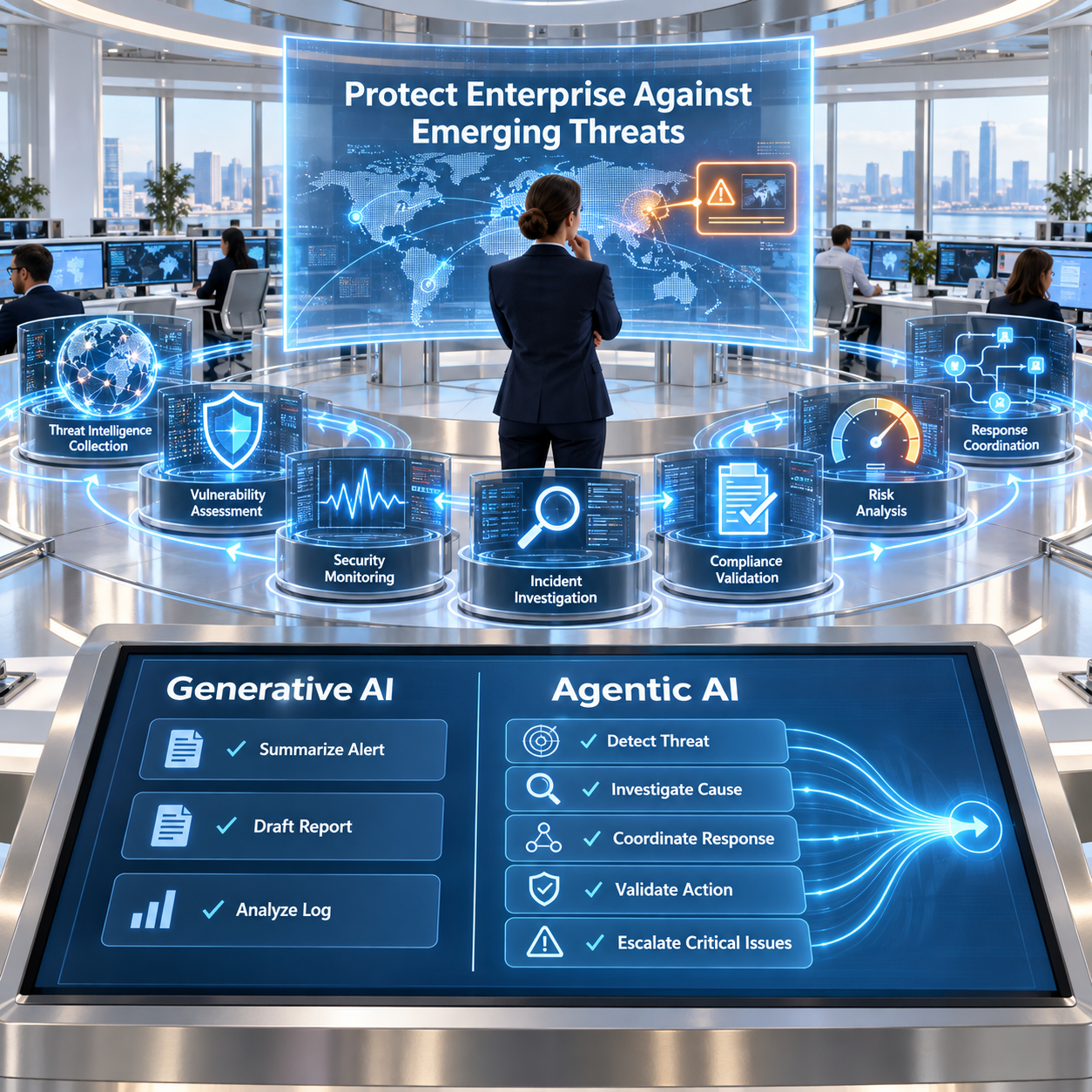
Instead of simply helping people complete individual tasks faster, AI agents can potentially coordinate and execute multiple steps within an entire workflow.
That shift, from task acceleration to workflow automation, could represent one of the next major productivity gains for businesses.
What Is the Difference Between Generative AI and Agentic AI?
Generative AI and agentic AI share many underlying technologies, but they differ in how they support work.
Generative AI Responds to Requests
Generative AI is particularly effective at creating and transforming information.
It can:
- Draft emails and documents
- Summarize meetings and reports
- Generate code
- Analyze information
- Create images and presentations
- Answer questions based on available knowledge
These capabilities help employees complete individual tasks more efficiently.
But in many traditional generative AI workflows, a person remains responsible for initiating each step.
They request the summary.
They review the information.
They decide what happens next.
They provide the next instruction.
The technology accelerates the work, but the person continues to coordinate the process.
Agentic AI Can Work Toward an Objective
Agentic AI takes that concept further.
An AI agent can be given an objective and work through multiple steps toward achieving it.
Depending on its design, available tools, permissions, and operating boundaries, an agent may be able to:
- Gather information from connected systems
- Evaluate possible next steps
- Execute approved actions
- Coordinate activities across applications
- Check results and adjust its approach
- Escalate exceptions for human review
Rather than waiting for a new instruction after every task, the agent can continue working toward a defined outcome.
That does not mean every AI agent operates independently or should be trusted with unrestricted authority.
The level of autonomy should depend on the workflow, the consequences of errors, and the controls established by the organization.
The Biggest Productivity Opportunity Is Reducing Human Handoffs
Consider preparing for a customer meeting.
With generative AI, an employee might:
- Ask AI to summarize previous meeting notes.
- Request research on the customer's current challenges.
- Ask for a proposed agenda.
- Review open issues and identify discussion topics.
- Request a draft follow-up email.
Each activity happens faster.
But the employee still coordinates the entire process.
With agentic AI, the workflow could look different.
An authorized agent could gather relevant customer information, review previous interactions, identify unresolved issues, prepare a briefing, and create a proposed agenda.
After the meeting, it could potentially organize notes, identify follow-up actions, and prepare communications for review.
The employee remains responsible for the customer relationship and important decisions.
But they no longer need to initiate every individual step.
That distinction matters.
Generative AI reduces the time required to complete tasks. Agentic AI can reduce the number of times people need to intervene in the workflow.
Why Agentic AI Could Create Greater Enterprise Productivity
Organizations spend significant amounts of time coordinating work between people, applications, and departments.
Information is collected from one system.
A report is generated in another.
Someone reviews the information.
A request moves to another team.
An approval is obtained.
The next task begins.
Even when individual tasks are efficient, the overall workflow may still be slow.
Agentic AI creates an opportunity to reduce that friction by coordinating activities across approved systems.
Potential benefits include:
- Faster completion of multistep workflows
- Fewer unnecessary manual handoffs
- More consistent execution of routine processes
- Reduced administrative coordination
- Faster access to relevant information
- Greater employee capacity for complex work
The opportunity is not simply to make every step faster.
It is to reconsider how many steps actually require human involvement.
What Agentic AI Means for Cybersecurity Operations
Security teams provide a useful example of where agentic AI could create meaningful value.
Security operations often involve multiple systems, repetitive investigations, and time consuming information gathering.
An analyst responding to a suspicious event may need to review alerts, retrieve logs, examine endpoint activity, consult threat intelligence, document findings, and determine whether escalation is necessary.
Generative AI can accelerate several of those activities individually.
Agentic AI could potentially coordinate them into a more complete investigation workflow.
For example, an authorized security agent might:
- Retrieve relevant alerts from a security platform
- Gather associated endpoint and identity information
- Compare activity against approved threat intelligence sources
- Organize evidence into an investigation summary
- Identify information gaps
- Prepare recommended next steps for analyst review
The analyst still evaluates the evidence and determines the appropriate response.
But much of the repetitive coordination can happen before that decision.
Practical Security Implementation Ideas
Security organizations can begin with two focused approaches.
1. Automate investigation preparation. Start with an agent that gathers relevant evidence, enriches alerts, and prepares incident summaries without independently taking disruptive response actions.
2. Streamline vulnerability management. Use an agent to collect vulnerability findings, associate them with asset information, identify relevant remediation guidance, and prepare prioritized recommendations for human validation.
These use cases offer an opportunity to reduce manual work while maintaining control over consequential security decisions.
Agentic AI Introduces New Security and Governance Requirements
The shift from generating information to taking action creates an important distinction for enterprise security.
A generative AI system that produces an inaccurate summary may create an information quality problem.
An agentic AI system that acts on inaccurate information could create an operational or security incident.
The difference is authority.
When AI agents interact with enterprise applications, retrieve sensitive information, modify records, or initiate actions, organizations need to understand exactly what those agents are permitted to do.
Agentic AI governance should address:
- Identity and access: What systems and information can the agent access?
- Permissions: Which actions can it perform?
- Data protection: What sensitive information can it process or share?
- Human oversight: Which decisions require approval?
- Monitoring: How will agent activity be observed and reviewed?
- Accountability: Who owns the workflow and its outcomes?
- Exception handling: What happens when the agent encounters uncertainty or failure?
These controls become especially important when agents can take actions across multiple connected systems.
Practical Security Implementation Ideas
1. Apply least privilege to AI agents. Give agents only the permissions required for their approved workflows. Separate read-only information gathering from actions that modify data or systems.
2. Establish approval and monitoring controls. Require explicit human authorization for high impact actions, maintain activity logs, and provide mechanisms to pause or disable agents when unexpected behavior occurs.
Agentic AI should operate within a defined security framework rather than receive broad access simply because it can complete a task.
Human Oversight Becomes More Important as AI Gains Autonomy
Agentic AI does not eliminate the need for people.
It changes where human involvement creates the greatest value.
Instead of performing and coordinating every step, employees may increasingly focus on:
- Defining objectives
- Establishing acceptable boundaries
- Reviewing exceptions
- Evaluating results
- Making consequential decisions
- Improving the workflow over time
This requires a different management approach.
Leaders need to decide which workflows can operate with limited intervention and which require ongoing human involvement.
A routine internal information gathering process may be appropriate for substantial automation.
A workflow involving financial transactions, privileged security actions, sensitive customer information, or irreversible decisions may require stronger oversight.
The objective is not maximum autonomy.
It is the appropriate level of autonomy for the risk involved.
Organizations Should Redesign Workflows Before Deploying Agents
One of the biggest mistakes organizations could make is introducing agentic AI into inefficient processes without reconsidering how those processes should operate.
Automating unnecessary steps does not automatically create a better workflow.
Before deploying an AI agent, leaders should ask:
- What outcome are we trying to achieve?
- Which steps create meaningful value?
- Which steps exist primarily because of historical limitations?
- Where is human judgment essential?
- Which actions can safely be automated?
- How will we measure success?
These questions help organizations move beyond technology deployment toward meaningful process improvement.
Practical Enterprise Implementation Ideas
1. Start with a bounded workflow. Select a repetitive process with clear inputs, predictable outputs, limited permissions, and measurable outcomes. Test the agent under supervision before expanding its authority.
2. Measure the entire process. Evaluate total completion time, manual handoffs, error rates, exception frequency, and outcome quality rather than simply measuring how quickly the agent performs individual tasks.
This approach makes it easier to demonstrate value while identifying operational and security risks early.
Measure Workflow Outcomes, Not Just Task Speed
Agentic AI may require organizations to rethink how they measure productivity.
With generative AI, success is often measured through time saved on individual activities.
How much faster was the document drafted?
How quickly was the report summarized?
How much time did research take?
Those measures remain useful.
But agentic AI introduces broader questions.
Did the entire workflow finish faster?
Were unnecessary handoffs eliminated?
Did the process require fewer human interventions?
Was the outcome accurate?
Were security and compliance requirements maintained?
Did employees gain more capacity for work requiring judgment?
These are more meaningful measures of workflow automation.
The value comes not simply from faster individual tasks, but from improving how the entire process operates.
Final Thoughts
Back to the two assistants.
Generative AI is the highly capable assistant waiting for the next assignment.
Agentic AI is beginning to resemble the project coordinator who understands the objective and keeps the work moving.
That difference may have a significant impact on enterprise productivity.
Generative AI helps people do individual tasks faster.
Agentic AI creates the possibility of completing coordinated workflows with fewer manual interventions.
But greater autonomy also requires clearer boundaries, stronger governance, appropriate permissions, and human accountability.
The organizations that benefit most will not simply deploy the largest number of AI agents.
They will identify the workflows where greater autonomy creates measurable value and design the controls needed to operate those workflows safely.
Because the next productivity shift may not come from helping employees complete one more task faster.
It may come from allowing entire workflows to move forward without requiring someone to orchestrate every step.
FAQs: Agentic AI, Enterprise Productivity, and Security
1. What is the main difference between generative AI and agentic AI?
Generative AI primarily creates or analyzes information in response to requests, while agentic AI can coordinate multiple steps toward an objective and, when authorized, interact with systems and execute actions. The primary distinction is the ability to manage parts of a workflow rather than simply accelerate individual tasks.
2. How can security teams safely introduce agentic AI?
Security teams should begin with limited, clearly defined workflows such as alert enrichment, evidence gathering, or vulnerability reporting. Agents should operate with least privilege, activity logging, defined escalation criteria, and human approval for consequential actions. Permissions can be expanded gradually as reliability and control effectiveness are demonstrated.
3. Will agentic AI eliminate the need for human oversight in enterprise workflows?
No. Agentic AI can reduce routine human intervention, but organizations still need people to establish objectives, define permissions, validate important outcomes, manage exceptions, and remain accountable for decisions. Higher risk workflows generally require stronger human oversight, particularly when agents can modify systems, access sensitive data, or take actions that are difficult to reverse.
Want to be the first to know when new blogs are published? Sign up for our newsletter and get the latest posts delivered straight to your inbox. From actionable insights to cutting-edge innovations, you'll gain the knowledge you need to drive your business forward.