AI Changes the Work, Not the Need for Accountability
Think about a restaurant kitchen during a busy dinner rush.
The head chef cannot personally touch every plate.
They cannot stand over every cook, approve every ingredient, or inspect every movement before food leaves the kitchen.
If they tried, service would grind to a halt.
Instead, the kitchen works because responsibility is distributed.
Each person knows their station.
They understand the standards.
And they are accountable for the quality of what they produce.
That same principle becomes increasingly important as AI gives employees more capability and greater autonomy at work.
There is a temptation to assume that when AI performs more of the work, accountability somehow becomes less clear.
In reality, the opposite should happen.
The more organizations rely on AI, the more clearly they need to define who owns the outcome.
AI Can Produce an Answer, but Someone Still Owns the Result
AI can draft a document.
It can summarize a meeting.
It can analyze information.
It can recommend an action.
It can automate parts of a workflow.
But someone still needs to determine whether the result is accurate enough, appropriate for the situation, and aligned with organizational standards.
Accountability cannot disappear into the technology.
If a customer receives inaccurate information, "the AI did it" is not a useful operating model.
If an AI assisted recommendation contributes to a poor decision, the organization still needs to understand who was responsible for reviewing and acting on that recommendation.
The same principle applies when an automated workflow makes a mistake or when an AI generated output should have received additional review.
AI changes how work is performed.
It does not eliminate the need for ownership.
Organizations Need Clear AI Ownership
As AI becomes embedded in everyday workflows, organizations need to answer several fundamental questions:
- Who owns the final outcome?
- When is human review required?
- Which activities can be automated from beginning to end?
- Which decisions require explicit human approval?
- Who monitors the performance of an AI assisted process?
- Who is responsible when an exception occurs?
- When should employees escalate rather than act?
These questions should be answered before AI becomes deeply embedded in critical processes.
Without clear ownership, organizations can create accountability gaps where employees assume the technology is responsible and leaders assume employees are responsible.
That ambiguity becomes especially dangerous in security, compliance, financial, legal, and customer facing workflows.
Human Oversight Should Match the Risk
Not every AI generated output requires the same level of human review.
A first draft of an internal meeting summary presents a very different risk than an AI recommendation involving privileged access, sensitive customer data, or a significant financial decision.
Organizations should design oversight based on potential consequences.
Lower risk and easily reversible activities may require limited review.
Higher risk activities may require explicit human approval before action occurs.
Practical Security Implementation Ideas
Organizations can:
- Classify AI use cases according to security, privacy, regulatory, financial, and operational risk
- Define an accountable owner for every production AI workflow
- Establish clear human review requirements for higher risk decisions
- Create escalation thresholds for unusual or uncertain AI outputs
- Document who can approve changes to automated workflows
- Maintain audit trails for important AI assisted decisions
The objective is not to manually review everything.
It is to ensure someone clearly owns what matters.
Security Teams Need Clear Accountability Too
Cybersecurity provides a useful example of why ownership matters.
AI can help summarize alerts, prioritize vulnerabilities, correlate threat intelligence, draft incident reports, and recommend response actions.
Those capabilities can significantly increase security team capacity.
But an AI recommendation should not create uncertainty about who owns the security decision.
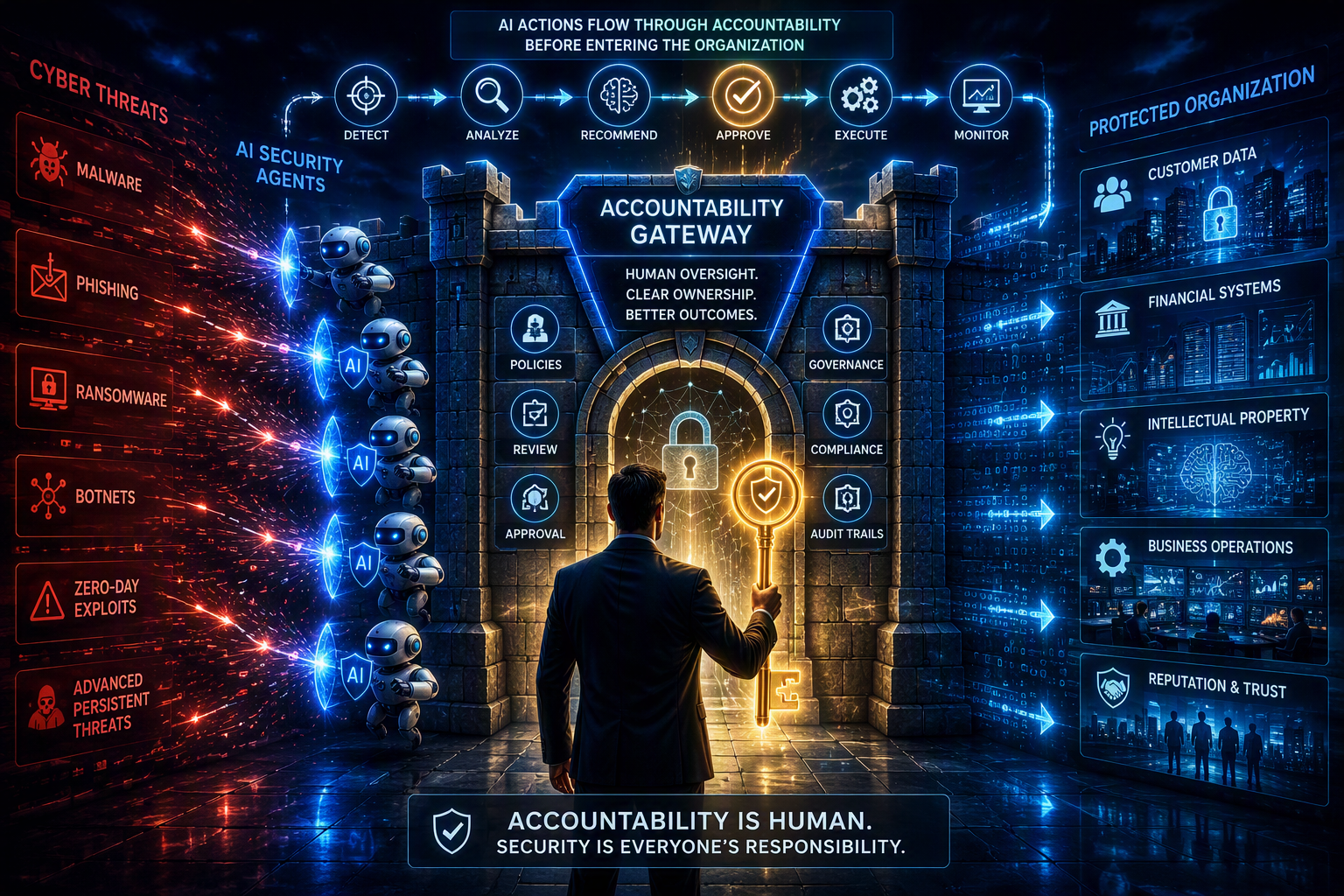
If AI recommends isolating a critical system, who approves the action?
If a vulnerability is classified as low priority, who accepts the risk?
If AI generated incident information is communicated to leadership, who validates the facts?
If an automated security workflow behaves unexpectedly, who has authority to stop or override it?
Practical Security Implementation Ideas
Security leaders can create responsibility matrices for AI assisted workflows that identify:
- The business owner
- The technical owner
- The security owner
- The person responsible for final approval
- Required escalation paths
- Conditions that require human intervention
This creates clarity before an incident or failure forces the organization to determine responsibility under pressure.
Greater Autonomy Requires Greater Accountability
AI can allow employees to make more decisions without waiting for constant managerial approval.
That can be a significant advantage.
But autonomy and accountability need to increase together.
The objective is not to give employees greater freedom and then monitor every action more closely.
It is to make ownership clear.
Employees should understand where they have authority, what outcomes they are responsible for, and when circumstances require escalation.
That creates a healthier operating model than forcing every decision through multiple approval layers.
People can move faster because they understand the boundaries.
Managers can focus on exceptions rather than routine activity.
And accountability remains clear even as work becomes more distributed.
AI May Shift Management From Tasks to Outcomes
Clear AI accountability could also improve how organizations manage people.
Traditional management often focuses heavily on process.
Was every step followed?
Was every task completed?
Did every approval happen?
As AI takes over more routine steps, leaders have an opportunity to focus more heavily on outcomes.
Did the result meet the required standard?
Was the information accurate?
Was the decision appropriate given the available evidence?
Were security and compliance requirements followed?
Did the person responsible exercise good judgment?
This does not mean processes stop mattering.
It means organizations can become clearer about which processes exist because they create necessary control and which exist simply because that is how work has historically been done.
Build Accountability Into AI Governance
AI governance should therefore include more than approved tools, acceptable use policies, and data protection requirements.
It should establish ownership.
For every meaningful AI workflow, organizations should know who is responsible for the system, the decision, the outcome, and the exceptions.
That accountability should remain understandable even when multiple systems and teams contribute to the process.
AI may perform more of the work.
Responsibility should not become more difficult to locate as a result.
Final Thoughts
Back in the restaurant kitchen, speed comes from distributing the work.
Quality comes from making sure everyone understands exactly what they own.
AI will work much the same way.
Organizations do not need leaders personally reviewing every AI generated output or approving every automated action.
They need clear standards, appropriate guardrails, defined escalation paths, and people who understand where responsibility sits.
The organizations that benefit most from AI will not be the ones where nobody is quite sure whether the person or the technology is responsible.
They will be the ones where accountability remains clear and human, even when more of the work does not.
As AI takes on more work inside your organization, ownership should become clearer, not more ambiguous.
FAQs: AI Accountability, Governance, and Security
1. Who should be accountable when AI makes a mistake?
Organizations should define human ownership before deploying an AI assisted workflow. Accountability may involve different business, technical, and security roles, but there should always be clear responsibility for reviewing important outputs, making decisions, monitoring the system, and handling exceptions.
2. Which AI activities should require human review?
Human oversight should generally increase with the potential impact of an action. Activities involving sensitive data, security controls, regulatory obligations, significant financial consequences, customer impact, or difficult to reverse decisions typically warrant stronger review than low risk administrative tasks.
3. How can security teams establish accountability for AI
Want to be the first to know when new blogs are published? Sign up for our newsletter and get the latest posts delivered straight to your inbox. From actionable insights to cutting-edge innovations, you'll gain the knowledge you need to drive your business forward.