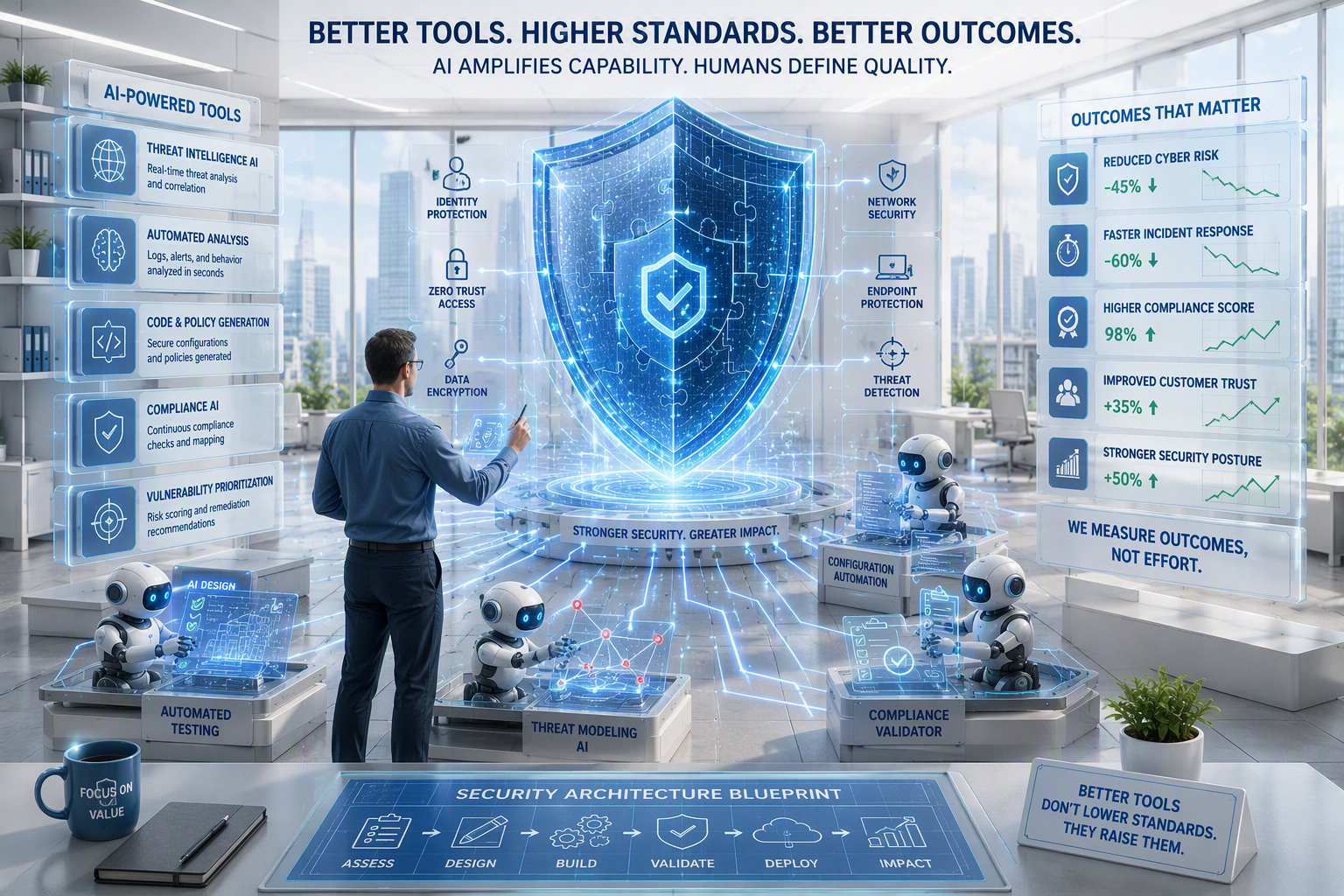
Better AI Tools Should Raise the Standard for Work
Think about a carpenter building a cabinet by hand.
For years, the quality of the work might have been judged partly by how long it took, how many steps were involved, and how much skill was required to shape every piece manually.
Then imagine giving that carpenter better tools.
The finished cabinet may take half the time to build. Some manual steps disappear. The process changes dramatically.
But the standard for the cabinet should not get lower.
If anything, better tools should allow us to expect more.
That is the challenge organizations are beginning to face with AI.
AI is changing how much effort is required to produce certain kinds of work. As that happens, organizations also need to reconsider how they define productivity, performance, and quality.
Effort Has Never Been the Same as Value
For years, organizations have often used activity as a proxy for productivity.
Hours worked.
Tasks completed.
Reports produced.
Meetings attended.
Emails answered.
Projects touched.
These measures are visible and relatively easy to track.
But they do not necessarily tell us whether meaningful value was created.
AI makes that distinction increasingly difficult to ignore.
A document that once required three hours might now take thirty minutes.
A first pass analysis that consumed half a day might be produced in minutes.
A repetitive administrative process that once filled an afternoon might happen almost automatically.
The employee may be spending less time producing the work.
That does not mean the work has become less valuable.
It means effort is becoming a less useful measure of value.
AI Should Push Organizations Toward Outcome Based Performance
As AI becomes embedded in everyday workflows, organizations have an opportunity to shift their attention from activity to outcomes.
Instead of asking how many hours were spent, leaders can ask:
- Was the decision better?
- Did the customer receive a faster answer?
- Was the work more accurate?
- Was risk reduced?
- Did the employee solve a more difficult problem?
- Did the team create something that moved the business forward?
These questions create a much more meaningful definition of productivity.
The goal of AI should not simply be to increase the volume of work employees produce.
It should be to improve the impact of that work.
More Output Does Not Mean Better Work
Generative AI makes producing content remarkably easy.
Organizations can create more presentations.
More reports.
More emails.
More summaries.
More analysis.
But increased output can create its own problems.
If employees generate twice as many reports but nobody needs them, productivity has not necessarily improved.
If AI creates lengthy analysis that contains inaccurate assumptions, speed has not created value.
If employees generate more information than colleagues can realistically review, AI may simply move the bottleneck somewhere else.
The ability to produce more makes judgment increasingly important.
Someone still needs to determine what is useful, what is accurate, what deserves attention, and what should never have been created in the first place.
Quality Standards Become More Important With AI
As AI reduces the effort required to create work, organizations may need stronger definitions of what acceptable work looks like.
That is particularly important in environments where accuracy, security, compliance, or customer trust matter.
An AI generated document might look polished while containing incorrect information.
An AI assisted analysis might reach a convincing conclusion based on incomplete data.
An automated security report might save hours while failing to include important context.
Speed cannot become a substitute for quality.
Practical Security Implementation Ideas
Organizations can:
- Establish quality standards for common AI generated outputs
- Define when AI produced information requires independent verification
- Require source validation for higher risk analysis
- Create human review requirements based on the consequences of an error
- Measure accuracy and decision quality alongside time savings
- Monitor whether increased AI output is creating unnecessary information or additional review burden
The goal should be better work produced more efficiently, not simply more work.
Security Teams Should Measure Outcomes Too
The same shift applies to cybersecurity.
Security teams have traditionally measured activity through metrics such as alerts processed, vulnerabilities identified, reports completed, or tickets closed.
Those measures can be useful.
But AI makes it easier to process larger volumes of activity, which means volume alone becomes an even weaker indicator of security performance.
If AI allows a security team to review twice as many alerts, the important question is not simply whether alert volume increased.
The better questions are:
Did analysts identify meaningful threats faster?
Did response times improve?
Did false positives decrease?
Did the organization reduce exposure?
Did analysts have more time for proactive security work?
Practical Security Implementation Ideas
Security leaders can:
- Pair productivity metrics with risk reduction metrics
- Measure improvements in investigation and response times
- Track whether AI reduces repetitive analyst work
- Evaluate the quality of AI assisted security recommendations
- Reinvest recovered capacity into threat hunting, architecture, resilience, and strategic risk management
AI productivity should ultimately improve security outcomes, not simply security activity.
Managers Need to Rethink Performance Expectations
AI also creates an important management question.
What happens when an employee can complete the same work in half the time?
One response is to double their workload.
But that risks turning every productivity improvement into an expectation to simply produce more.
A better approach is to determine where the newly available capacity can create greater value.
That might mean spending more time:
- Solving complex problems
- Developing new skills
- Working with customers
- Improving existing processes
- Coaching colleagues
- Analyzing risks
- Testing new ideas
AI creates capacity.
Management determines whether that capacity becomes additional activity or additional value.
Redefining Good Work Requires Better Metrics
Organizations should reconsider performance metrics as AI changes workflows.
For each AI assisted process, leaders can evaluate four dimensions:
Quality: Did the output meet or exceed the required standard?
Impact: Did the work create a meaningful business or security outcome?
Efficiency: Did AI reduce unnecessary effort or cycle time?
Judgment: Did the employee use AI appropriately, validate important information, and escalate when necessary?
Together, these measures provide a more complete picture than hours worked or outputs produced.
They also reinforce an important principle.
Using AI effectively should not mean lowering expectations.
It should create an opportunity to raise them.
Final Thoughts
Back to the carpenter.
When better tools make the work faster, we should not judge success by how many hours the saw was running.
We should judge the cabinet.
AI will push organizations toward the same conclusion.
As the amount of effort required to produce work changes, the definition of good work needs to change with it.
Hours worked will tell us less.
Output volume will tell us less.
What will matter increasingly is the quality of the result, the judgment behind it, the risk involved, and the value it creates.
The organizations that adapt successfully will not simply use AI to produce more.
They will use AI to expect better.
FAQs: AI, Productivity, and Performance Measurement
1. How should organizations measure employee productivity when AI reduces the time required for work?
Organizations should place greater emphasis on outcomes, quality, accuracy, decision making, and business impact rather than relying primarily on hours worked or output volume.
2. How should security teams measure AI driven productivity?
Security teams should connect AI efficiency to outcomes such as faster investigations, improved response times, reduced repetitive work, better risk prioritization, and increased capacity for proactive security activities.
3. Should employees receive more work simply because AI makes them faster?
Not automatically. Organizations should consider whether recovered capacity can be invested in higher-value activities such as complex problem solving, customer engagement, strategic planning, professional development, and risk reduction rather than simply increasing workload.
Want to be the first to know when new blogs are published? Sign up for our newsletter and get the latest posts delivered straight to your inbox. From actionable insights to cutting-edge innovations, you'll gain the knowledge you need to drive your business forward.