
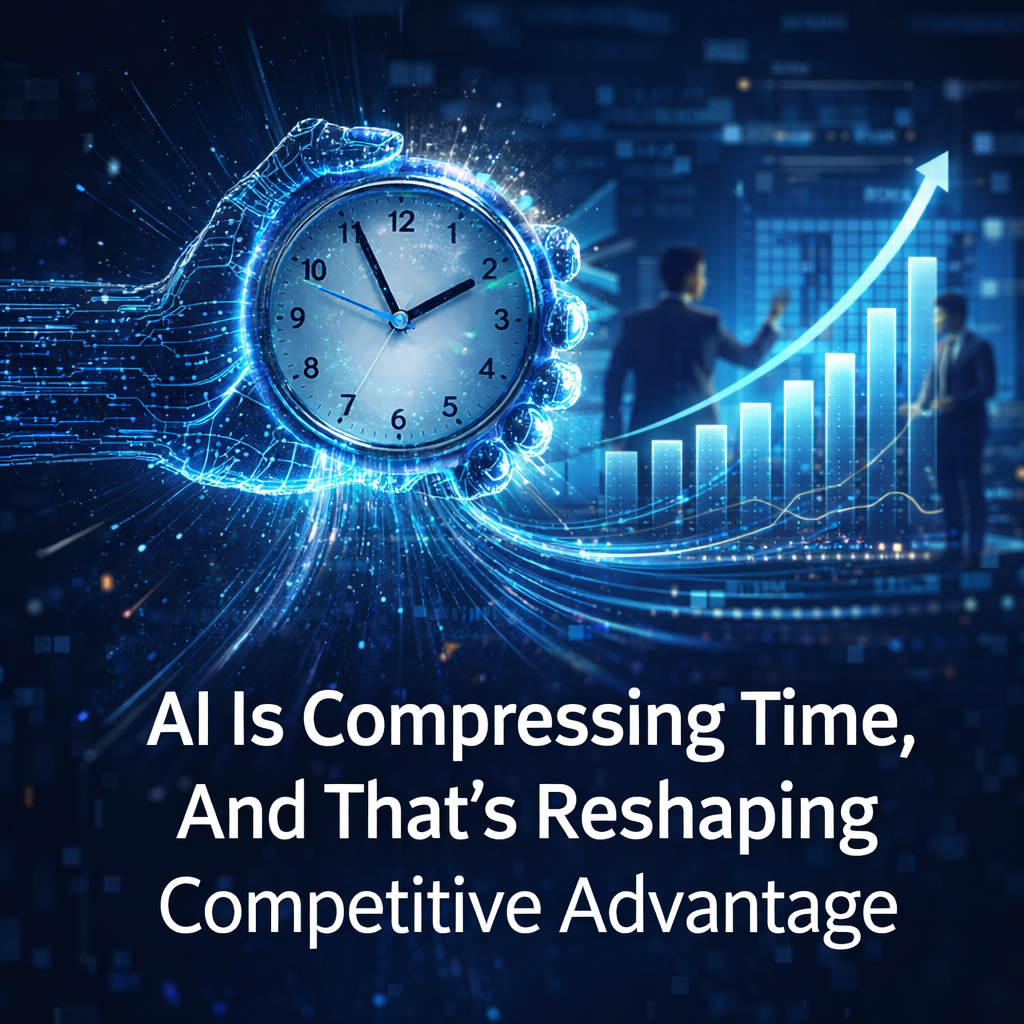
Speed Is No Longer a Differentiator, It’s the Baseline
There was a time when speed set companies apart.
Responding faster, delivering faster, and iterating faster helped organizations win. But it was not required just to remain competitive.
That is changing.
AI is not only improving how work gets done. It is compressing how long work takes.
Tasks that once required hours now take minutes.
Work that took days can be completed in an afternoon.
Analysis that sat untouched for weeks can now be done on demand.
As time compresses, expectations rise with it.
How Time Compression Changes Customer Expectations
Customers no longer compare your performance to your past.
They compare it to the fastest experience they have had anywhere.
If one vendor responds in minutes and another responds in hours, the slower experience no longer feels standard. It feels broken.
This is how competition shifts.
It is not just about who adopts AI and who does not. It is about who resets the pace of business.
Organizations that apply AI effectively are not simply becoming more efficient. They are redefining what acceptable performance looks like.
Faster proposals.
Faster onboarding.
Faster issue resolution.
Faster decision making.
Once that standard is set, everyone else is measured against it.
Why This Matters for Security and Operations
Many organizations underestimate this shift.
They view AI primarily as an internal efficiency tool, something that reduces workload or improves margins.
It does both.
But more importantly, it transforms external experience and operational expectations.
From a security perspective, this introduces new realities:
- Faster response expectations for incident detection and remediation
- Increased pressure on security teams to reduce investigation time
- Greater demand for real time analysis and decision support
If one organization can detect and respond to threats in minutes while another takes hours, the slower response is no longer acceptable. It becomes a measurable risk.
Practical Security Implementation Ideas:
- Use AI to accelerate threat detection and triage across high volume alerts
- Implement AI assisted analysis to reduce incident response time
- Automate repetitive investigation steps to improve response consistency
Speed, in this context, directly impacts risk exposure.
Time Compression Creates Competitive Momentum
The impact of AI driven speed is not linear, it compounds.
When organizations operate faster, they:
- Learn faster
- Iterate faster
- Improve faster
This creates momentum.
The gap between organizations that adopt AI effectively and those that delay does not remain constant. It widens over time.
Faster organizations gain more feedback, refine processes more quickly, and continuously improve their operations.
Slower organizations fall further behind with each cycle.
AI Is Not Just Efficiency, It Is Experience
When AI reduces turnaround time, the impact extends beyond internal metrics.
If a team delivers a proposal in one day instead of one week, that is not just efficiency. It is a competitive advantage.
If support issues are resolved in minutes instead of hours, that is not just cost savings. It directly impacts customer trust and retention.
The same applies to security.
Faster detection, faster containment, and faster remediation do not just improve internal performance. They strengthen resilience and reduce business risk.
The Bar Is Moving, Whether You Move or Not
This does not mean every organization needs to overhaul operations overnight.
But it does mean the baseline is shifting.
AI is not just helping organizations do more work. It is redefining how quickly “good” needs to happen.
From both a competitive and security standpoint, speed is becoming an expectation rather than an advantage.
Final Thoughts
In an environment shaped by AI driven time compression, the question is no longer whether AI creates advantage.
It is how long an organization can afford to operate without it.
Because as the pace of business accelerates, standing still is no longer neutral.
It is falling behind.
FAQs: AI, Time Compression, and Security Impact
1. How does AI driven speed impact cybersecurity operations?
AI reduces detection and response times, enabling teams to process large volumes of alerts and act faster. This lowers risk exposure and improves overall security posture.
2. Why does time compression create competitive risk?
As some organizations move faster, customer expectations shift. Slower response times begin to feel like failures, which can impact trust, retention, and market position.
3. Where should organizations start to keep up with AI driven speed?
Focus on high volume, time sensitive workflows such as incident triage, reporting, and analysis. These areas provide immediate gains in speed and measurable impact on both operations and security.
Want to be the first to know when new blogs are published? Sign up for our newsletter and get the latest posts delivered straight to your inbox. From actionable insights to cutting-edge innovations, you'll gain the knowledge you need to drive your business forward.